
Municipalities squander R1.09 trillion of taxpayer funds



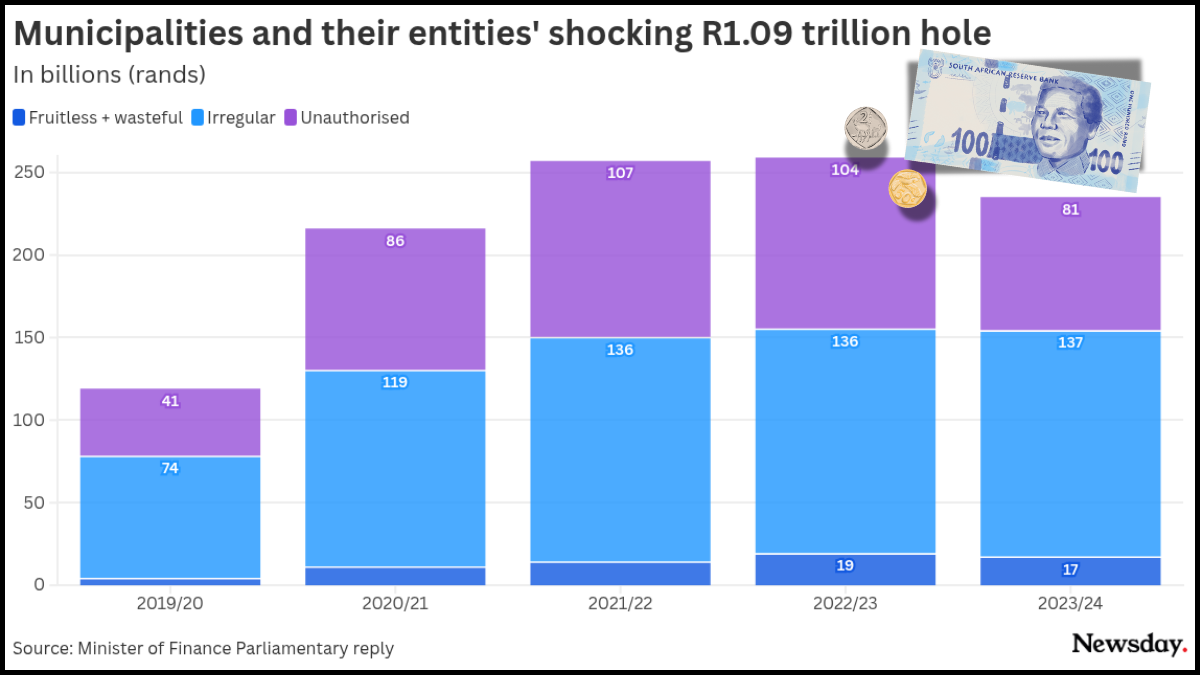
Municipalities and municipal entities have reported more than R1.08 trillion in fruitless, wasteful, irregular, and unauthorised expenditure between the 2019/20 and 2023/24 financial years.
The figures were provided by the Minister of Finance, Enoch Godongwana, in a recent parliamentary response to a question from ActionSA MP Alan Beesley.
The answers cover three main categories of expenditure: fruitless and wasteful expenditure, irregular expenditure, and unauthorised expenditure.
Fruitless and wasteful expenditure refers to money spent unnecessarily or ineffectively, often due to negligence or poor planning, resulting in resources being wasted.
Irregular expenditure occurs when funds are spent in violation of laws, regulations, or procurement procedures, even if the spending itself was necessary, such as awarding a contract without following proper tender processes.
Unauthorised expenditure arises when money is spent without approval or exceeds the budget allocation, meaning the spending was not legally sanctioned.
Looking at the information provided by the Minister, over the past five financial years, municipalities and their entities reported, in billions of rands:
| Year | Fruitless + Wasteful | Irregular | Unauthorised |
|---|---|---|---|
| 2019/20 | 4 | 74 | 41 |
| 2020/21 | 11 | 119 | 86 |
| 2021/22 | 14 | 136 | 107 |
| 2022/23 | 19 | 136 | 104 |
| 2023/24 | 17 | 137 | 81 |
To put this into perspective, proper allocation and use of these funds could have transformed key public services across the country.
In healthcare, the Department of Health’s budget for 2023/24 stood at R58.6 billion, projected to rise to R66.4 billion by 2026/27.
The lost funds could have funded the national health budget for two decades, allowing for the construction of hospitals, procurement of equipment, and recruitment of additional staff.
Similarly, in education, the Department of Basic Education’s annual budget of R50.1 billion could have been sustained for over 27 years, enabling new schools, better learning materials, and more educators.
No accountability and consequence
Beesley said that unless stricter oversight, enhanced auditing, and tangible consequences for non-compliance are implemented, public trust and government efficiency will continue to suffer.
“It is clear that there is no accountability and consequence for public officials. Until incompetent and corrupt officials are either fired or jailed, nothing will change,” Beesley told Newsday.
“Everything rises and falls on leadership, and sadly competent and honest leadership is missing with most state departments and entities.”
Godongwana said that “yes, the amounts of unauthorised and irregular spending remain unacceptably high,” highlighting weaknesses in oversight and enforcement.
The Auditor General has warned that the persistent scale of irregular and unauthorised spending highlights both systemic and cultural weaknesses in public financial management.
While South Africa’s Public Finance Management Act (PFMA) and Municipal Finance Management Act (MFMA) set strict reporting and compliance requirements, enforcement remains inconsistent.
The massive sums, Godongwana said, have direct implications for service delivery.
In his 2025 budget, the finance minister proposed a comprehensive spending review to cut unproductive projects, audits to root out issues like ghost employees, and budget adjustments to save R40 billion without raising VAT.
He said the government also aims to strengthen institutions and improve governance, focusing on better management and oversight of public funds.
Success, however, will depend on rigorous implementation and sustained political will, with the public and business sectors closely watching for tangible improvements in service delivery.










 Loading ...
And if you DON’T yet know, the Cape Town City is required to send almost R80 BILLION to the National Government every year – of which the city gets a measly R5 BILLION ‘allocated’ back. So the Western Cape’s money (DA) is actually FUNDING the corrupt ANC municipalities and the rot! In addition, Western Cape as a whole sends R260 BILLION to the National Government each year – and gets only R80 BILLION ‘allocated’ back. Now that we have a GNU, the DA ‘ministers’ would rather protect their little positions and salaries in the ANC-run circus, than REVOLTING against Western Cape money being wasted/stolen elsewhere via ‘BEE’ ‘deals’ and ‘contracts’.