
BEE laws used to cover ANC corruption – Helen Zille


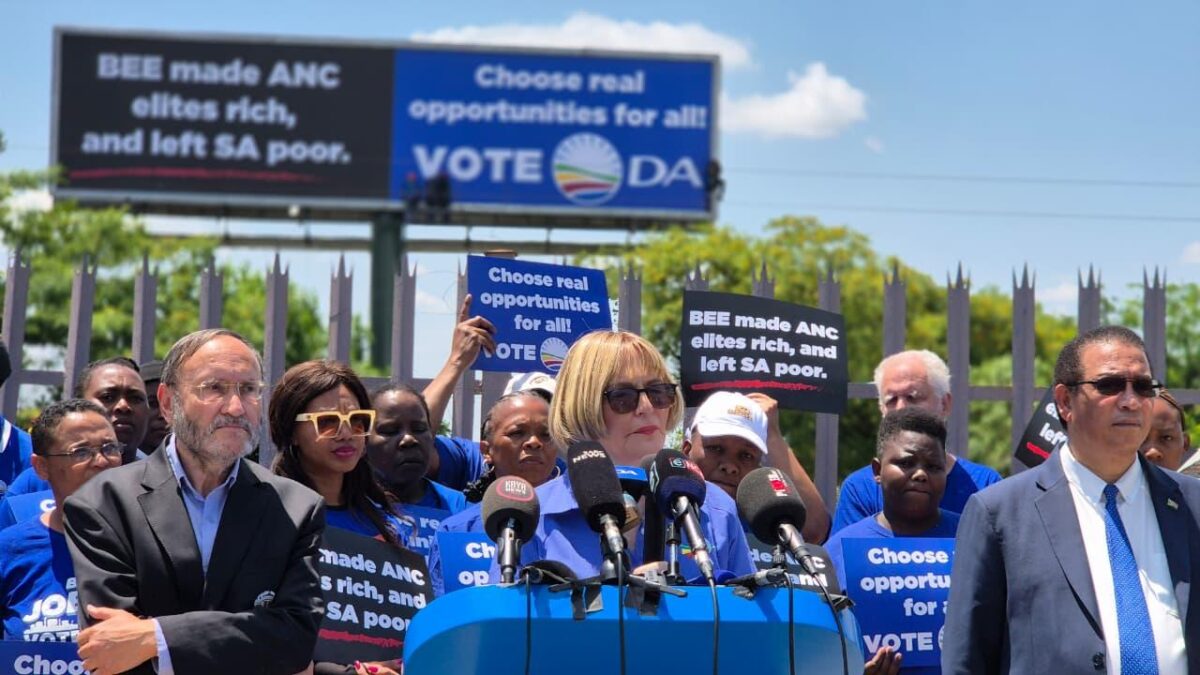
Helen Zille, the Chairperson of the Federal Council of the Democratic Alliance, said BEE often legalises what other countries would consider pure corruption.
Zille shared her views on black economic empowerment (BEE) during an interview with Radio 702’s Clement Manyathela.
Zille slated black economic empowerment in its current form, saying it prevents competition and limits international investments.
The chairperson of the DA’s Federal Council said requiring people to give away a third of their company to do business in South Africa chases international investors away.
“Saying you must give away a third of your company to a politically connected member of the ANC elite is bad news,” he said.
“The minute you start doing favours for politicians in patronage networks, it is the end of your business over time.”
Zille added that there are many examples of how BEE has been a form of extortion to make a few politically connected individuals rich.
She highlighted Gold Fields’ R2.1-billion BEE transaction to comply with South African mining regulations.
The transaction was investigated by the US Securities and Exchange Commission (SEC) for allegations of improper influence, including bribes.
The United States’ SEC concluded its investigation in 2015 and did not recommend enforcement action against Gold Fields.
However, the deal resulted in internal fallout, including the resignation of the legal head and the CEO waiving his bonus.
Zille said the deal, facilitated by Gayton McKenzie, which made many people extremely wealthy, was nothing more than extortion.
“In South Africa, this extortion is legalised by BEE laws. It actually legalises what many other countries view as corruption,” she said.
She also cited former President Jacob Zuma, who said that he merely used black economic empowerment and did nothing wrong.
“I asked Jacob Zuma when he was president about the bad things which happened under state capture,” she said.
“He replied, I did nothing wrong. I was just applying Broad-Based Black Economic Empowerment (B-BBEE).”
DA proposes a BEE alternative

The DA has proposed scrapping BEE, through its Economic Inclusion for All Bill, introduced in October 2025.
This private member’s bill aims to fundamentally reform South Africa’s transformation policies by repealing race-based elements in public procurement and broader empowerment legislation.
Introduced amid ongoing debates in the Government of National Unity (GNU), the DA argues that BEE, enacted in the early 2000s to redress apartheid-era inequalities, has failed in its core mission.
Instead of delivering broad-based upliftment to the majority of disadvantaged South Africans, the policy has enriched a narrow, politically connected elite while deterring investment, stifling job creation, and enabling corruption.
The party highlights persistent high unemployment, poverty affecting millions, and economic stagnation as evidence that race-based quotas and preferential scoring in government contracts have not worked.
The DA contends that BEE contradicts constitutional principles of fairness, equity, transparency, competitiveness, and cost-effectiveness in public procurement.
The Economic Inclusion for All Bill seeks to amend the Public Procurement Amendment Act of 2024 by removing race-based preferential provisions and replacing them with a needs-based system.
Poverty would serve as the primary proxy for disadvantage, shifting focus to merit, skills development, job creation, entrepreneurship, and alignment with Sustainable Development Goals.
This approach, the DA claims, would promote genuine inclusion for all South Africans regardless of race, unlocking opportunities and fostering sustainable growth.
Transitional measures include winding down the BEE Commission over 12 months and systematically removing BEE references from legislation.
Critics, including the ANC, COSATU, and others, have strongly opposed the proposal, viewing it as a rollback of hard-won struggle gains and ignoring the enduring legacy of apartheid that continues to disadvantage the black majority.
President Cyril Ramaphosa has defended BEE as constitutionally rooted, while some GNU partners have signaled reluctance to support it.
The bill faces significant hurdles in Parliament, but the DA insists it reflects the urgent need for economic reform to benefit the poor and unemployed.



















 Loading ...
BEE enabled dollars to be kept under sofas, mansions that are above the earnings, looting of hospitals, comrades became billionaires very soon, Cat Matlala is now behind bars for assisting ANC enriching themselves through BEE. Helen Zille should not let lie this BEE for comrades of ANC, EFF and MKP.