
DA officials lost their positions after United States visit



Members of the Democratic Alliance’s (DA) delegation to the United States in February are no longer in the senior roles they held when they boarded the plane.
The trip, led by then Deputy Minister of Trade, Industry and Competition Andrew Whitfield and international relations spokesperson Emma Powell, was described as a working visit to “stabilise diplomatic relations between South Africa and the US during this period of heightened tensions.”
The DA said the two travelled in their capacity as party representatives, not government officials. Whitfield acted as Eastern Cape party provincial leader and federal executive member, and Powell was the DA’s national spokesperson on foreign affairs.
But fallout from the visit has since exposed deepening divisions in the Government of National Unity (GNU), particularly over foreign policy.
The Presidency, the Department of International Relations and Cooperation (DIRCO), and the African National Congress (ANC) accused the DA of “spreading disinformation” abroad and undermining South Africa’s diplomatic position.
The DA, which holds just over 30% of the GNU bloc, has pushed for a shift in foreign policy. The ANC, which commands about 55% of the GNU, has resisted this direction.
During their week-long visit to Washington, Powell said the two MPs had engaged with US leaders “to ensure that they receive accurate and fact-based information regarding South Africa’s domestic landscape and the challenges our nation is currently navigating.”
She later said the discussions “reinforced the need to rebuild bilateral trust,” while the DA allegedly heard criticism of policies like BBBEE and called for a focus on means-based redress and property rights.
The DA said it had delivered “fact-based insights” and sought to “counter misinformation,” including in meetings held at the White House.
First delegate gets the chop

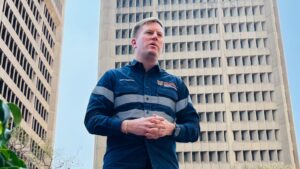
In June, President Cyril Ramaphosa dismissed Whitfield over an unauthorised overseas trip, citing constitutional grounds.
Ramaphosa said that while it was “not common practice” for him to provide reasons for the appointment or removal of members of his executive, “due to several unfortunate statements and outright distortions by a number of people”, he saw it fit to publicly comment.
“Mr Whitfield was removed as a deputy minister because he undertook an international visit without the permission of the president,” said Ramaphosa.
“His travel to the US was a clear violation of the rules and established practices governing the conduct of members of the executive.”
According to these rules, any international travel undertaken by ministers or deputies “must always be undertaken with the express permission of the president”.
Ramaphosa confirmed that he alerted DA leader John Steenhuisen prior to Whitfield’s removal and asked him to submit a replacement name “as the DA is entitled to a deputy minister as agreed.”
The DA accused Ramaphosa of a “flagrant double standard” following Whitfield’s dismissal, warning that failure to meet its ultimatum would carry consequences for the ANC.
In an interview with the SABC, he said that his dismissal may have had other motives, calling it “premature” and “provocative.”
Whitfield remains a MP as well as the Leader of the DA in the Eastern Cape.
Emma Powell next

On 28 July, Emma Powell resigned from her two-year stint as the DA’s international relations spokesperson.
“Given the complexities of our fragile Government of National Unity, I have achieved what I can for and in this moment. We must each do what is possible to tip the world’s axis towards freedom, but good leaders know when it is time to step back and allow others to carry the baton forward,” she said.
DA spokesperson Willie Aucamp said that “Powell has voluntarily and, of her own accord, decided to resign as the DA’s spokesperson on International Relations.”
While Powell described her resignation as the result of “careful reflection,” it followed an incredibly tumultuous period in the GNU.
Foreign policy had become a flashpoint, with deep divisions between the ANC-led DIRCO and Powell’s DA approach on issues such as Taiwan, Russia, and MTN’s ties to Iran, the latter involving MTN chair and Ramaphosa’s US envoy, Mcebisi Jonas.
Presidency spokesperson Vincent Magwenya accused the DA of trying to “embarrass and belittle” South Africa and aligning with a “right-wing nexus” to influence domestic policy through foreign channels.
The ANC and DIRCO released multiple statements accusing Powell of running “disinformation campaigns.”
The Department of Trade, Industry and Competition also claimed the DA was undercutting sensitive US trade negotiations.
The Sowetan later reported that a National Security Council (NSC) document accused her of spreading disinformation abroad and undermining South Africa’s foreign and domestic policy.
“It is clear that there is an insidious political agenda at play, in which taxpayer-funded state security services are potentially being weaponised against sitting MPs in order to achieve political objectives,” Powell responded.
“As the ANC continues to engage with its friends in the axis of malign actors, the likes of Russia and Iran, the DA will continue to openly and constructively engage with the international community of democracies,” she concluded.
News24 reported that DA leader John Steenhuisen had blocked several of Powell’s statements, exposing internal tensions.
But Aucamp insisted to Newsday that “reports that there were ongoing differences of opinion between her and the DA’s leadership are simply untrue… there was no pressure whatsoever.”
He added a new portfolio would soon be assigned and that Powell would bring “the same dedication” to her new role.
Powell, who remains an MP, said in her letter: “In defending South Africa’s constitutional values on the international stage, I have been threatened, intimidated, harassed, and illegally surveilled.”
“Many of these regimes are more closely enmeshed with government leaders and the Dirco than the public realises.”
“Driven by my commitment to the DA’s foundational principles, I accepted these risks as the unavoidable cost of standing up to and exposing Dirco and the ANC’s relationships with authoritarian regimes.”
She declined further comment.

 Loading ...
The DA undermines SA’s diplomatic relations with the US? No way.
Because they criticise guys like Rasool?
Nice US diplomacy when the ANC continually call each other ‘comrades’?