
The key to getting South Africa back on track



While recovering South Africa’s rail freight sector has been on the African National Congress (ANC)’s agenda for over a decade, the past few years have seen efforts finally gain momentum.
This is according to Professor Jan Havenga from Stellenbosch University’s Department of Logistics who says that while several promises have been made, there has been significant progress over the past three years.
However, he argues this goes unnoticed because of a lack of investment in the country’s core rail network.
“Accelerating the recovery of the freight and logistics sector” was listed as the second priority on the ANC’s 10-point plan to solve the country’s “economic emergency.”
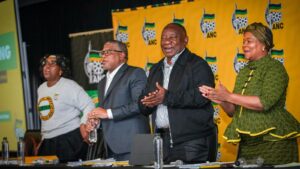
The ANC announced the plan, “which will focus on implementation and service delivery,” in early October, following a special National Executive Committee (NEC) meeting in Birchwood, Gauteng.
ANC President Cyril Ramaphosa said this signals “the urgency and intent of the ANC” as the party attempts to address an economic emergency.
However, the ANC has been highlighting South Africa’s logistics crisis, primarily caused by a significant decrease in the usage of South Africa’s rail infrastructure, thanks to persistent challenges in governance, funding, and execution, for more than a decade.
According to data sourced by The Outlier, just under 60% of land freight was transported via roads in 2010. This has since risen to over 85% as of July 2025.
Empty promises?

The most notable promise by the ANC to tend this worsening crisis, was the National Development Plan (NDP), launched in 2012, which was intended to serve as a roadmap for South African policy until 2030.
Ramaphosa was the deputy chairperson of the commissioners tasked with formulating the NDP, which was adopted as government policy in 2013.
At the time, the NEC was briefed on the NDP, which was approved as a “necessary guide to ensure that the country has a clear plan and vision that will address the social and economic challenges facing South Africa.”
The document noted that at the time 69% of all road freight was transported via road, which strained the country’s road network, already facing significant maintenance backlogs.
To address this issue, the NDP has set out several goals to be completed by 2030 to meet the country’s freight and logistics needs.
These included renewing the country’s commuter train fleet, improving road infrastructure, improving the Durban-Gauteng corridor, as well as coal transport corridors, and the North-South corridor.
However, a review of the NDP after ten years revealed that significant shortages in the freight sector persist, attributed to the reduced ability of state-owned enterprises, such as Transnet, to invest in infrastructure.
During his 2015 State of the Nation address, then-President Jacob Zuma announced a Nine-Point Plan to support the goals of the NDP.
This addressed several issues facing the country, including the energy crisis and the role of SOEs.
The eighth point titled “Boosting the role of state-owned companies, information and communication technology infrastructure and broadband roll-out, water, sanitation, transport infrastructure,” prioritised rail and port infrastructure upgrades.
As part of this initiative, South Africa also signed a cooperation agreement with the People’s Republic of China (PRC) to develop the Moloto Rail Development Corridor, which remains incomplete.
The 2023 turnaround

Havenga, who was part of the team that helped turn Transnet into a public enterprise in 1990, says that many of the company’s problems are structural and can be traced back to before the ANC came into power.
He said that Transnet’s first managing director, Anton Moolman, told him in a recent interview that there were two issues facing the company: its pension fund deficit and its general railway freight business being unsustainable.
“When the ANC took over, they got rid of the old management and the new management never addressed the issues,” Havenga said.
“Then the next major contributor to the downfall of Transnet was state capture, which heavily affected the entity.”
However, despite these legacy issues and the company being further picked apart by state capture looters, Havenga says that the government has shown determination to fix what has been broken.
The first sign the ANC government was confronting the situation, he says, was President Cyril Ramaphosa’s State of the Nation Address (SONA) in 2023, where he outlined South Africa’s “roadmap for change.”
At the time, Havenga and three other rail and freight experts, had been tasked with creating the road and rail strategy for Operation Vulindlela, which aims to modernise and transform South Africa’s core network industries.
Following the SONA, Business Leadership South Africa helped create the National Logistics Crisis Committee.
Then in September 2023, the late Pravin Gordhan, who was Minister of Public Enterprises at the time, instructed the Transnet board to test the competency of the company’s management.
Havenga says this resulted in the resignation of many of those in charge, including the CEO, Group CEO, and Chief of Railways.
He said that new leadership, which includes acting CEO Michelle Phillips, has helped to “completely turne things around.”
“They stopped the massive decline in freight rail usage dead in its tracks over a relatively short period of time and it has been increasing ever since.”
Hegenda also praised Minister of Transport, Barbara Creecy who he says is incredibly hard working and focused on fixing the issue.
“I have known all the transport ministers since about 1979 on a personal level, and I think she is the best of the lot,” he said.
However, while there has been significant momentum in turning around the freight and logistics sector in South Africa, Havenga argues that Transnet’s core network is still a major issue.
“I think it is important governemnt remains the owner of the country’s railways. The Minister has appealed to the private sector to invest in the network to help maintain the railways through concessions. So there is progress being made,” he argued.
“However, it will be difficut to notice the hard work being put in in other areas until we deal with the problem of the our core network.”



 Loading ...