
Hundreds of corruption probes in South Africa



The Special Investigating Unit (SIU) is at the centre of South Africa’s anti-corruption efforts, probing allegations of fraud, maladministration, and procurement irregularities in government departments and state-owned entities.
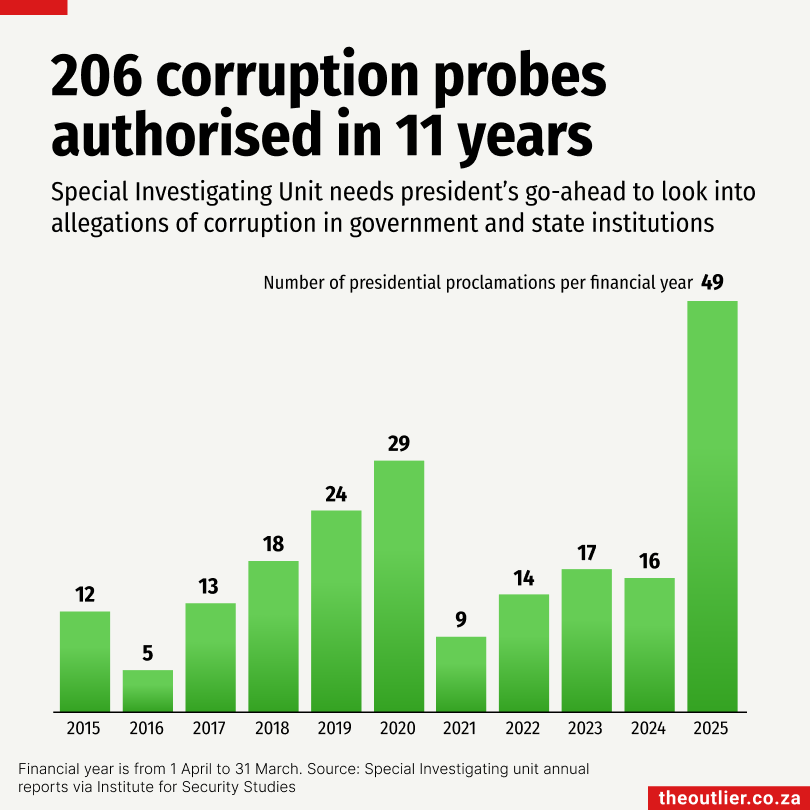
In the past 11 years, South African presidents have authorised 206 corruption probes by the SIU, a figure revealed by data journalism outlet The Outlier when probing annual reports.
Yet as the number of investigations climbs, so too do concerns about the unit’s independence, capacity, and overall effectiveness.
Broadly, the SIU’s core function is to safeguard public resources by investigating and addressing financial crimes, including corruption, fraud, and maladministration, within government departments, state-owned enterprises, and other public institutions.
It is meant to go beyond merely exposing wrongdoing by:
- Recovering losses through civil litigation.
- Referring cases for criminal prosecution via agencies like the NPA.
- Recommending reforms to address systemic governance failures.
- Instituting disciplinary actions for officials implicated in misconduct.
The SIU’s investigations typically focus on high-value or high-impact cases, such as irregular procurement processes, mismanagement of public funds, or abuse of power by officials.
Its work spans national, provincial, and local government levels, as well as state-owned enterprises like Eskom, Transnet, and the Passenger Rail Agency of South Africa (PRASA).
A contentious issue is that the SIU cannot initiate investigations on its own accord; it requires a presidential proclamation to probe specific allegations or entities.
According to the Special Investigating Units and Special Tribunals Act of 1996, this requirement is so that the SIU’s work is focused and legally authorised, preventing overreach while aligning investigations with areas of significant public concern.
As of the latest available data, the presidency has issued over 300 proclamations covering a wide range of sectors and issues since the SIU’s establishment.
These proclamations have addressed allegations ranging from procurement irregularities in government contracts to mismanagement in state-owned enterprises and fraud in public welfare programs.
The steady issuance of proclamations reflects the persistent challenge of corruption and maladministration in South Africa’s public sector.
Cyril Ramaphosa’s probe push
Since Cyril Ramaphosa assumed the presidency in February 2018, there has been a marked increase in the use of presidential proclamations to authorise SIU investigations.
Of the 300 proclamations issued since 2001, 165 (55%) have been issued during Ramaphosa’s tenure.
This surge aligns with Ramaphosa’s public campaign promises of a “new dawn” of rooting out corruption and restoring integrity to public institutions, following the state capture era under his predecessor, Jacob Zuma.
Ramaphosa was deputy president throughout Zuma’s second term.
The 2024/2025 financial year stands out as particularly active, with 49 proclamations issued, the highest annual total in the SIU’s history.
Mixed reactions

It has been noted that the SIU has recovered billions in looted public funds, exposed major corruption networks and driven disciplinary and prosecutorial action through referrals to the NPA.
However, critics have raised the alarm over the SIU’s reliance on presidential proclamations, warning of potential political interference.
Political analyst Ralph Mathekga said in a 2021 interview with eNCA that “the SIU is a powerful tool, but its dependence on presidential proclamations means it’s only as independent as the political will behind it.”
“If the President chooses not to issue a proclamation for a sensitive case, the SIU’s hands are tied.”
A 2022 report by Corruption Watch emphasised that the SIU’s effectiveness is curtailed by its structural dependence on the presidency.
Without automatic investigative powers, there is always a risk that politically inconvenient cases could be sidelined.
Resource constraints, mounting case backlogs, and slow judicial processes further hamper its impact.
The shortage of funding and skilled staff affects both speed and quality. “We are working with a lean team,” SIU head Advocate Andy Mothibi had told Parliament, urging more resources to accelerate probes.
Even when investigations conclude, legal processes drag: “The SIU can uncover corruption… but the wheels of justice turn slowly,” a News24 article noted.
Implementation of SIU recommendations remains patchy, especially in municipalities, while coordination with the NPA and Hawks is often bogged down by bureaucracy.






 Loading ...