
Over R2 billion looted from one public hospital in South Africa



The Special Investigating Unit (SIU) has revealed what it describes as a “devastating plunder of the public purse” at Tembisa Hospital, exposing three coordinated syndicates responsible for siphoning off over R2 billion intended for healthcare services.
The interim report, released on Monday, paints a picture of widespread fraud, procurement irregularities, and maladministration at one of Gauteng’s largest hospitals, and signals the depth of corruption facing South Africa’s public health system.
Adv. Andy Mothibi, head of the SIU, said that “this staggering sum, intended for the provision of healthcare to the most vulnerable, was instead ruthlessly siphoned off through a complex web of fraud and corruption.”
The SIU’s investigation has involved the analysis of 2,207 procurement bundles, revealing extensive irregularities in the awarding of contracts and the management of public funds.
A total of 207 service providers have been implicated, linked to 4,501 purchase orders (POs) that were supposedly processed through a competitive three-quote procurement system.
Investigators allege that this system was manipulated to facilitate fraudulent payments to key officials and syndicate members.
These numbers are constantly updated as new companies are identified through ongoing investigations and as the flow of funds involving irregularly awarded contracts is traced, the SIU said.
The probe was set in motion after the assassination of whistleblower Babita Deokaran, a single mother of a daughter and chief accountant at the Gauteng Department of Health.
Investigations by News24 uncovered how Deokaran had flagged R850 million of suspicious Tembisa Hospital payments that had occurred over just a few months, just days before she was brutally murdered.

The syndicates
Analysis of the procurement bundles revealed widespread maladministration.
Each purchase order was linked to a purported three-quote procurement process, which is supposed to ensure competitive bidding and accountability.
In reality, investigators say, these processes were manipulated to benefit specific companies and individuals.
The SIU confirmed that the total value of matters under investigation currently stands at R2,043,293,404.10, with numbers likely to rise as more irregularities and additional companies are identified.
The interim report identifies three major syndicates involved in the misappropriation of funds. Among them is the Mazibuko syndicate, linked to Rudolph Mazibuko.
The SIU reviewed 651 procurement bundles valued at R283 million, of which 392 analyses have been completed.
These investigations revealed assets worth R42 million, including multiple properties in the Western Cape, allegedly acquired through ill-gotten gains.
Next named was the Maumela syndicate, linked to Hangwani Morgan Maumela, the nephew of President Cyril Ramaphosa from a previous marriage.
The SIU noted that this syndicate was involved in 1,728 bundles valued at R816 million, with 924 analyses completed.
The SIU traced 41 suppliers or service providers connected to the syndicate. Three of these companies, awarded contracts totaling R13.5 million, are linked to Vusimuzi “Cat” Matlala.
Assets identified include luxury vehicles and properties valued at R520 million, notably a R75 million property in Bantry Bay and multiple others in Gauteng.
Some of these assets have already been preserved through the National Prosecuting Authority (NPA) Asset Forfeiture Unit.
The third syndicate, while unnamed, had 1,237 procurement bundles, valued at R596,424,356.
An analysis of 646 bundles has revealed numerous procurement irregularities and identified secondary conduit accounts used to launder funds connected to the Tembisa Hospital.
Assets tied to this syndicate are valued at approximately R150,000,000.


Implicated officials
The SIU has identified at least 15 current and former officials from the Gauteng Department of Health and Tembisa Hospital involved in corruption, money laundering, collusion, and bid rigging.
Corrupt payments linked to these officials total R122,228,000.
To date, 116 disciplinary referrals have been prepared against 13 officials, with 108 already delivered to the GDOH.
Officials were found to have facilitated appointments of non-compliant service providers and improperly approved purchase orders, violating principles of segregation of duties and enabling syndicate activities.
SIU unpacked some reasons as to how this happened, including:
- Procurement Fraud: Service providers were often appointed using fraudulent documents and a manipulated three-quote system to bypass tender processes, keeping transaction values under R500,000.
- Syndicate Collusion: Numerous invoices showed collusion between service providers and officials, with duplicate or coordinated invoices submitted within short timeframes.
- Failed Oversight: The CEO of Tembisa Hospital and GDOH Head Office failed to flag irregularities, issuing compliance certificates to non-compliant bidders and approving purchase orders without concern.
- Links to Unsuccessful Bidders: Payments totaling over R1.1 million were made to purportedly unsuccessful bidders, indicating collusion or fronting among syndicate-linked companies.
The SIU’s review of medical supply spending revealed increases from R315 million in 2018/2019 to R598 million in 2019/2020, rising to nearly R979 million in 2021/2023.
Despite steady patient numbers, expenditure surged disproportionately, indicating mismanagement. After the a SIU secondment report in December 2022, spending dropped 73% from R948 million to R255 million in 2023/2024.
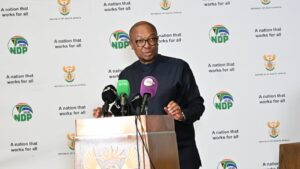
Speaking at the press briefing, health minister Dr Aaron Motsoaledi said that “the question I’m struggling with is, why Tembisa hospital? Why was it selected by so many syndicates?”
“When things like this happen, you start appreciating why the Chinese execute people to remove them from society.”
Next steps
The SIU emphasised that the interim report does not conclude the investigation. Further work is necessary to fully map the networks involved, recover misappropriated funds, and hold those responsible accountable.
Interim reports on related investigations, including those at Home Affairs, are expected in the near future.
“This is not just about money; this is about trust, public service, and the lives of the most vulnerable South Africans,” Mothibi said.
As investigations continue, the SIU has pledged to provide updates, ensuring that the scale of the corruption, the individuals involved, and the recovery of assets remain in the public eye.
The Tembisa Hospital case has already emerged as one of the most significant corruption probes in recent memory.
But as News24 investigative journalist Jeff Wicks said at the launch of his new book The Shadow State: Why Babita Deokaran had to die, Tembisa hospital is but one public hospital that has long served as a feeding trough for the corrupt.





 Loading ...
We want to SEE ALL these greedy corrupt ANC vultures and criminals SOON staring from behind bars asap!!! That includes politicians.
This was and is planned political sabotage and terrorism against SA economy!!!
STOP ALL project expenditure planned by ANC vultures with immediate effect