
R100 million taxpayer-funded project ripped apart brick by brick



In the heart of Soweto, Johannesburg, nearly 420 taxpayer-funded, two-bedroom family units have remained abandoned and vandalised for more than a decade, with only parts of the walls left standing at a roughly R100 million housing project.
Residents of the overcrowded Dube Hostel and surrounding areas say that because of this, they live in fear, as the abandoned Soweto Housing Project has become a haven for criminal activity, including drug use, robbery, and sexual assault.
Opened in October 1956, the Dube Hostel in Soweto was built under apartheid’s hostel scheme to house Black migrant workers from rural homelands on temporary work permits.
It became the site of violent clashes in September 1957, leaving multiple casualties and prompting an official inquiry by the Johannesburg City Council and the Institute of Race Relations.
Today, Dube Hostel remains one of the largest in Soweto, housing thousands of residents in overcrowded spaces.
In 2007/08, the Gauteng Department of Human Settlements (GDHS) launched a project to revitalise dilapidated and overcrowded hostels, with Dube among the targeted sites.
Aviva Manqa, former spokesperson for the provincial minister of housing, said at the time that “we want to do away with all the hostels as conceptualised under apartheid, where people being used as cheap labour were dumped in the areas and left to die with families so far away.”
The province reportedly spent R95 million building low-cost housing units adjacent to the hostel.
The first phase involved constructing 416 two-bedroom, double-storey family units, completed between 2009 and 2010, according to the city’s human settlements department.
Occupation was delayed because many hostel residents could not afford the rental and service costs and allegedly blocked other qualifying beneficiaries from moving in. Most hostel dwellers are unemployed or survive on odd jobs.
Residents initially believed the units were RDP houses and were shocked to learn they would have to pay rent. This left the units empty, vulnerable to vandalism, with water and sewer infrastructure stripped.
GDHS spokesperson Tahir Sema confirmed that 416 units had been vandalised when construction halted,
He cited residents’ inability to pay for rent under the Community Residential Unit programme, a 2014 ministerial moratorium on CRUs, and delays in township approvals and engineering design.
A resident who spoke to NewsDay on condition of anonymity, and who is one of the izinduna (headmen) at the hostel, explained the situation.
It is alleged that the housing department told them that houses would not be reserved exclusively for hostel dwellers, despite earlier assurances.
“The rent was far higher than what we had agreed on,” the source said.
“People started by breaking the windows. Soon after, trucks and vans arrived, and the roofs and bricks were ripped off. We could not stop them, we were threatened.”


The further fall of the site
Over R6.5 million was paid to security companies to guard Dube between 2012 and 2015. However, guards protecting the development eventually left due to payment disputes, worsening vandalism.
Police confirmed the site became a hotspot for muggings, and at times, dead bodies were found there.
Disputes over responsibility emerged in 2017. The City of Johannesburg claimed the GDHS was in charge, while the province insisted the City’s Housing Department had the role.
Former Gauteng Human Settlements MEC Paul Mashatile’s office said responsibility lay with the City, which should have secured funding, renovated the units, and allocated them to residents.
After this, the CoJ admitted that the Dube Hostel project was handed over to the city but there was “miscommunication” around who should take responsibility for security.
That led to security guards leaving the scene and the asset was then stripped of everything.
MEC Mashatile’s department then appointed a structural engineering company to assess damage caused by vandalism, years after the housing project was completed.
In a 2018 Parliamentary meeting, it was noted that the Dube Hostel was renovated with the Focused Intervention Study (FIS), where the renovation of one CRU there would cost R200,000, which they said was unfeasible
In 2019, the CoJ then launched a R34 million project with the Johannesburg Social Housing Company (Joshco) to revitalise three Soweto hostels, including Dube, yet the units remain in disrepair.
Although some renovations took place, they were almost immediately vandalised again.
The GDHS told Newsday that the hostel is now owned by the City of Johannesburg, which receives the Urban Settlement Development Grant to manage human settlements work.


A war zone
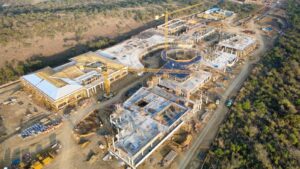
While there have been promises of making the site fit for purpose, Newsday’s September 2025 visit revealed what resembled a war zone: roofs stripped, steel fixtures removed, walls standing alone, and underground pipes dug out.
DA Gauteng shadow MEC for Human Settlements Mervyn Cirota took aim at both the GDHS and City of Johannesburg for a “glaring lack of accountability.”
“They can try pass the buck all they want, but this is just one of many taxpayer white elephants.”
He said that, along with many others, the stalled Dube Hostel project had deteriorated into a haven for criminals and urged Premier Panyaza Lesufi to investigate the delays, saying that responsibility ultimately rests with him.
On 2 September 2025, the City of Johannesburg council approved the Hostel Revitalisation Unitary Plan, tabled by Human Settlements MMC Mlungisi Mabaso, who actually grew up in the Dube Hostel.
The plan aims to transform hostels citywide, addressing decay through socio-economic surveys, improved management, and partnerships with developers to supplement government funding.
It also includes allocation and rental strategies and emphasises communication with residents to ensure participation.
“The adoption of this plan by the council is a significant boost for the people living in the hostels. It allows us to act swiftly in redeveloping the hostels and changing the way these spaces are perceived for the better,” said Mabaso.
Earlier this year, Mabaso said that the city needs at least R10 billion to revitalise and re-develop run down hostels across the city.
In an interview, Mabaso said that the abandoned Dube hostel will be redeveloped, with some structures demolished and others refurbished based on structural assessments.
Contractors are currently upgrading sewer and water infrastructure so that completed units can be connected and allocated. Before new allocations, residents will be profiled to ensure the redevelopment meets their needs, addressing issues from previous developments that did not align with residents’ requirements.
He noted that past problems, including wasteful expenditure of around R100 million, were the province’s responsibility, but resolving the issue is now a collective responsibility between the city and the province.
Once infrastructure upgrades are complete, the allocation of units will commence according to the approved redevelopment strategy.
IFP councillor Nkhosikhona Khanyile said this could restore dignity to hostels, where up to 14 people can share one room without any privacy.
The city’s Human Settlements Department has appointed two contractors to install water and sewer bulk infrastructure at Dube Hostel, marking progress toward allocating long-vacant units.
DCM Projects Professional is said to install water systems for over R14 million in five months, while Planet Earth will build sewer systems for R26.2 million in six months. Newsday will monitor this progress.
In the city’s 2025/26 budget, a revitalisation of the dilapidated project has been budgeted at R11 million.
More images of the Dube Hostel site today









 Loading ...
This is the responsibility of the “everything for free” culture