
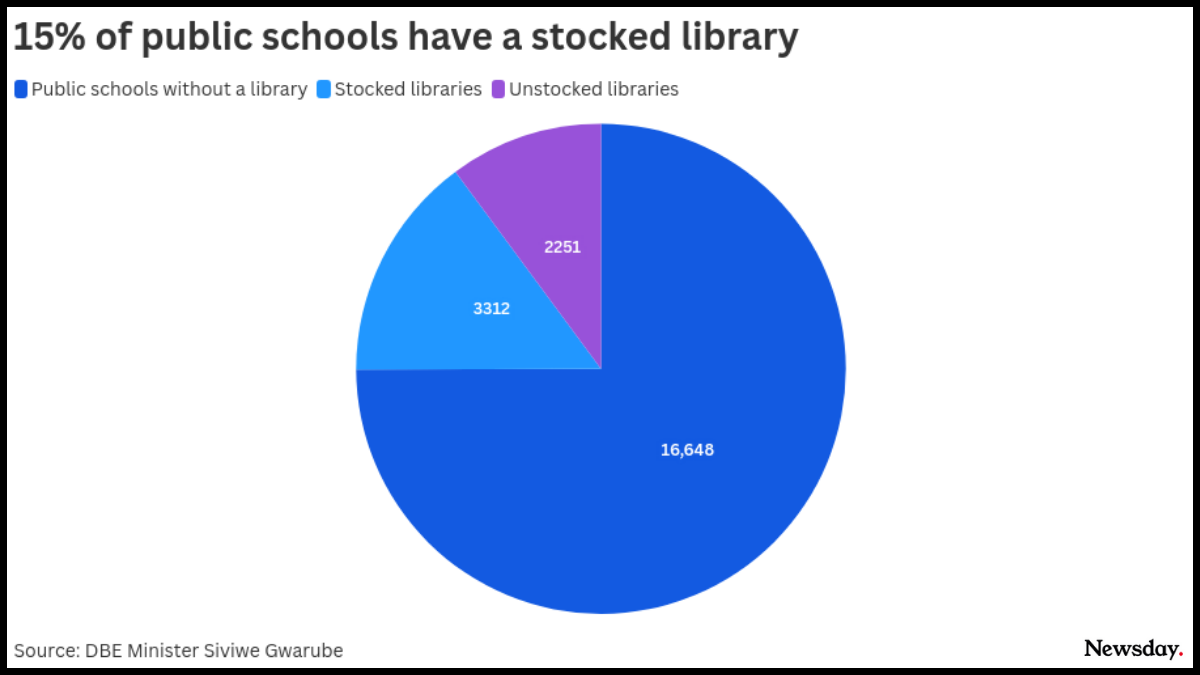
Less than 15% of public schools in South Africa have a functioning library



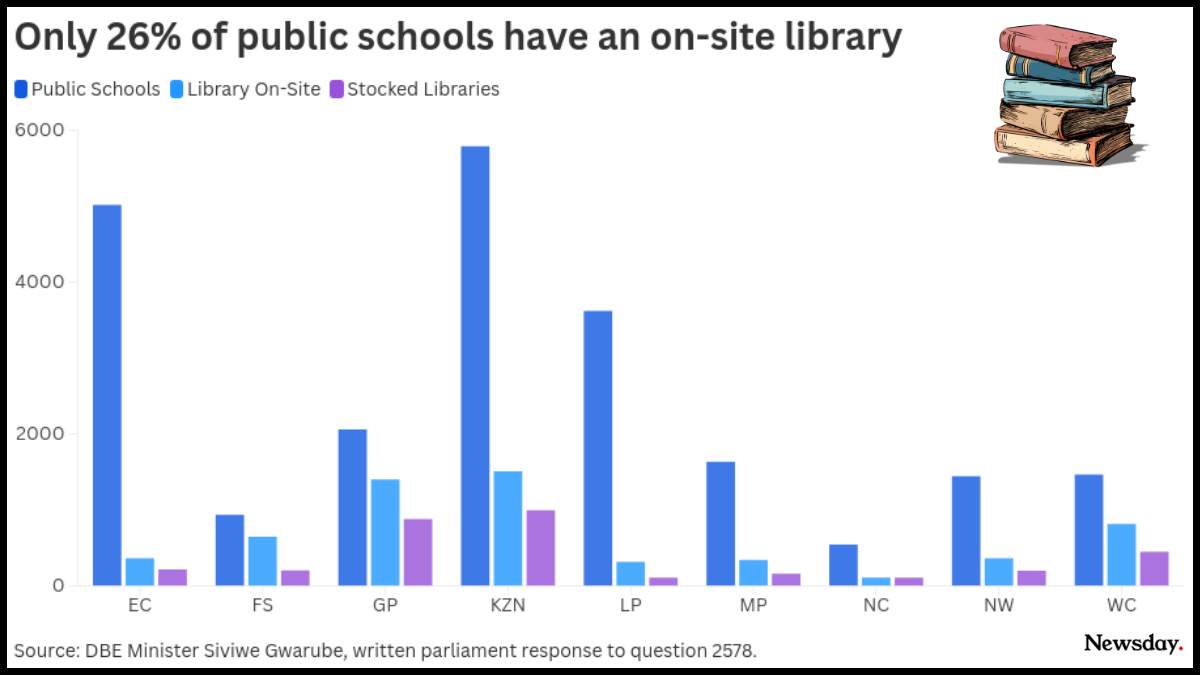
Only 26% of South Africa’s public schools have an on-site library, and just over half of these are properly stocked, according to Education Facility Management System (EFMS) data for 2024.
There are 22,511 public schools across the country, but only 26% have an on-site library. Of those, just 56.5% are considered stocked — meaning only about 15% of all schools have a functional library.
Basic Education Minister Siviwe Gwarube revealed these stark figures and disparities across provinces in a written reply to Parliament.
“According to the EFMS 2024 data, 26.0% of public schools nationally have libraries on-site,” Minister Gwarube said. “Of these, 56.5% are classified as stocked.”
In her response to the question posed by Build One South Africa leader Mmusi Maimane, Gwarube explained that a stocked library is one that meets a benchmark of four to six books per learner.
“The ideal number of books depends on school size, grade levels served and curriculum demands,” she said.
She added that for the Foundation Phase the Department of Basic Education (DBE) has begun supplying “a minimum package of 40 graded readers and 20 anthologies per classroom in 2024.”
The data highlights deep provincial inequalities. In the Eastern Cape, just 7.3% of schools have libraries, compared to 68.8% in the Free State and 68.1% in Gauteng.
Limpopo also lags at 8.7%, while the Northern Cape, though smaller, has 100% of its on-site libraries stocked.
However, the Minister noted that many school libraries face staffing and resourcing challenges. “Not all on-site libraries are managed by professional librarians.
In practice, they are often overseen by teachers with additional training, volunteers or school-appointed staff, due to systemic challenges,” Gwarube said.
She acknowledged that “a significant percentage of on-site libraries are not classified as ‘stocked’,” with some facilities repurposed as classrooms because of overcrowding.
To bridge the gap, Gwarube said the DBE is promoting a range of alternatives.
This includes “digital access through platforms such as Snapplify and other e-libraries; classroom-based solutions such as reading corners, trolleys and classroom libraries; mobile and outreach services, including book fairs and NGO-driven literacy initiatives.”
For schools without on-site library facilities, alternative measures include partnerships with community, public and private libraries; mobile library services; and school community library models.
The Minister stressed that school infrastructure delivery remains guided by minimum norms and standards, requiring provinces to plan and budget for libraries as part of their resource allocations.
Not good enough, says MPs
Maimane has called the lack of school libraries a direct contributor to South Africa’s literacy crisis.
He pointed to the PIRLS report, which found that “4 out of 5 learners in Grade 4 cannot read for meaning. In fact, only 1 in 5 learners at this foundational stage of schooling can make sense of what they are reading.”
Maimane said the data exposed entrenched inequalities in education, with learners in Gauteng far better resourced than those in Limpopo or the Eastern Cape.
“A library should not be considered a luxury. It is a cornerstone of learning, literacy, and opportunity,” he stressed.
He said that BOSA will file submissions to the new National Education and Training Council (NTEC), proposing reforms such as:
- Ensuring every school has a functional library within five years;
- Ring-fenced budgets for library infrastructure;
- Annual progress reports on delivery; and
- Stronger partnerships with civil society.
Beyond libraries, Maimane said BOSA’s vision includes an education ombudsman, improved teacher pay, a school voucher system, and a national teacher skills audit.



 Loading ...
The article doesn’t break down educational levels. I grew up in the UK and libraries were not available in schools until you reached senior level at 12/13 years of age. Even then for the first 2 years pupils were not allowed in the library. In the third year we were introduced to using the facility under strict supervision and control by a teacher. Regard for the care of books was paramount as they were expensive to buy and considered “precious”. My parents had taken me to the public library from the age of 7. The family budget didn’t allow for the purchase of books and to receive one on birthdays or Christmas was a great joy.