
Liam Jacobs is our weapon in Cape Town – PA



Announcing Liam Jacobs as the Patriotic Alliance’s (PA’s) mayoral candidate for the City of Cape Town was a strategic move to appeal to the city’s young voters, according to PA spokesperson Steve Motale.
“We have done our research, and a significant problem we face in South Africa is voter apathy among the youth. Young people complain that politicians tend to be old,” Motale told Newsday.
“If you look at Cyril Ramaphosa, he is 72 years old, and Helen Zille, the federal chairperson of the Democratic Alliance (DA), is 74.”
“As a result, young people feel that they do not resonate with these politicians, which is why we have selected a young candidate for Cape Town mayor,” Motale continued.
The spokesperson said that Jacobs, on the other hand, “is a young man that has a huge following among youth of all ages.” Therefore, the party believes he can turn things around in its favour.
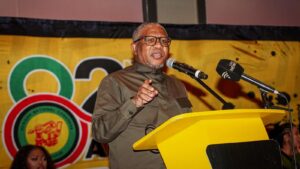
PA leader Gayton McKenzie announced on Monday that his party is “playing chess, not checkers” and that Jacobs has also been appointed president of the Patriotic Youth Alliance.
“I feel humbled to announce that the NEC of the PA has resolved to appoint me as the mayoral candidate for the City of Cape Town and as president of the Patriotic Youth Alliance,” Jacobs said.
Jacobs, who is 24, previously served as a DA Member of Parliament (MP) in the National Assembly and president of its student organisation, until defecting to the PA earlier in the year.
In an interview with EWN, DA Federal Chairperson Helen Zille claimed that there were “no hard feelings” over the young politician’s defection to the opposition.
“I like Liam, and I got on well with Liam,” adding that “it takes many years in politics to know that getting bashed about is part of what you bought into.”
“To know that you mustn’t take yourself too seriously, and to know that you’re going to get clapped from every single angle. You just have to dust yourself and get on with it.”
He has become an emerging face of South African politics, using a substantial social media following to do party work.
While it was reported that he would replace PA deputy president Kenny Kunene as Johannesburg MMC for the transport portfolio after his resignation, this did not materialise, but he was sworn in as a councillor.
It is understood that there was disagreement within the Johannesburg governing coalition, which the PA is a part of, about whether Jacobs had the experience to manage the position, given his lack of municipal experience.
However, his party clearly believes he is more than capable of taking on that responsibility, having put forward for the role of mayor in Cape Town.
Despite his suspension, the PA also announced that Kunene would be its mayoral candidate for the City of Johannesburg.
PA posing a threat to DA dominance in the Western Cape

Several recent by-elections have shown that the PA is seeing increased support in the Western Cape, where the DA has been dominant for years.
Elections analyst Wayne Sussman pointed to recent PA victories in municipalities across the province as signs that voter sentiment may be shifting.
In July, the PA upset a DA stronghold by taking Ward 9 of the Mossel Bay Municipality, in the Garden Route District, seeing a significant rise in support from 7% in the 2021 Local Government Election to 51% in the by-election outcome.
A few weeks later, PA councillor Veronica Maralack-Boonzaaier was elected in Ward 27 (Amstelhof) of the Drakenstein Municipality, which encompasses the towns of Wellington and Paarl.
The party had only obtained 1% of the vote in the 2021 LGE. However, skyrocketed to 43%, with the DA dropping from 58% to 39%.
“This is so important for the PA because the Cape Winelands District is the second-most populous district in the Western Cape after the City of Cape Town,” Sussman said.
“Voters in Stellenbosch and Paarl have generally been more loyal to the DA than in other parts of the province. So this means the PA are edging closer and closer to Cape Town.
Young people not voting

The Independent Electoral Commission (IEC) recently said that while there is a belief that young people are not voting because of apathy, its research suggests otherwise.
Political apathy occurs when people lose interest in politics, often due to feeling that the system does not work for them or voter fatigue.
“We do not ascribe to the understanding that there is apathy among young people. From our research, once registered, younger persons are more likely to vote than any other age cohort,” said the IEC’s Chief Electoral Officer, Masego Sheburi.
“In fact, they are ten times more likely to vote than any other age group. In the 2021 LGE, over 70% of young people who registered for the first time tuned out to cast their vote in the elections.”
In the 2024 elections, just over 11 million people aged 18 to 29 formed part of South Africa’s eligible voting age population (VAP). However, fewer than five million registered to vote.
On the other hand, the percentage of other cohorts that registered steadily increased with age. For instance, 67% of those aged 30 to 39 registered, 79% aged 40 to 49, and 90% aged 50 to 59.
Sheburi said that many young people do not vote because they have had fewer opportunities in the past than older generations.
The Executive Director of the Public Affairs Research Institute, Dr Sithembile Mbete, echoes the IEC’s generational theory of voter participation.
This suggests that people become increasingly interested in elections as they age, as a probable cause for a lack of youth participation.
However, she argues that South Africa’s high levels of youth unemployment mean many will be unable to “achieve the traditional markers of adulthood associated with electoral participation.”








 Loading ...
This is so typical grootbek McKenzie. He talked this promising young guy into defecting with big promises. Grootbek’s level of perception is clearly illustrated by the fact that he thinks this young guy can actually run Cape Town.