
The business taking over South African sports



Sports betting is taking over South African sports, with several major sports teams, including the Springboks and Proteas, and competitions sponsored by these businesses.
However, several studies have shown that the overexposure of these brands to sports audiences can encourage irresponsible gambling behaviour, with children particularly vulnerable.
In 2021, British betting company Betway signed a partnership with “South Africa’s most successful sports team, the Springboks, which would see the brand’s logo appear on the team’s shorts.
This was the first time that SA Rugby had been associated with a sports betting brand and would be renewed four years later in June 2025 for another four years.
Other South African rugby teams sponsored by betting companies include the Hollywoodbets Sharks, while SunBet and SportPesa have become the official betting partners of the Lions and Stormers, respectively.
Since first signing with the Springboks, Betway has continued establishing itself in South Africa. In 2021, it became the title sponsor of the Betway SA20 cricket tournament, which kicked off the following year.
Several of the tournament’s teams are also sponsored by sports betting companies, including the Durban Super Giants (1XBet), Joburg Super Kings (Dafabet), Paarl Royals (Stake), Pretoria Capitals (Batery), and Sunrisers Eastern Cape (Parimatch).
In August 2024, Cricket South Africa announced that Dafabet had become the official associate sponsor of the Proteas men’s and women’s teams.
Betway also signed a multi-year contract worth R900 million to become the title sponsor of the Premier Soccer League in 2024, which then became the Betway Premiership.
However, while these sponsorships may bring in much-needed revenue for these teams, they ultimately promote gambling.
“A ‘gamblification’ of sport has occurred over the last 25 years,” Nerilee Hing, Matthew Rockloff and Matthew Browne write in a paper titled A Bad Bet for Sports Fans: The Case for Ending the “Gambling” of Sport.
The study’s methodology entailed analysing over 140 studies conducted on gambling and sports betting.
They explain that gambling has become entrenched in professional sport because of a symbiotic relationship between sports organisations, the betting companies, media companies, governments, and sports audiences.
They say that these sports organisations earn significant revenue from sponsorships, profit-sharing agreements, selling data rights, and licensing fees.
“Revenues for wagering operators are derived from sports betting losses, which also yield substantial tax revenue to the growing number of governments that have legalised sports betting,” Hing et al. write.
Therefore, the revenue generated by these organisations, betting companies, and the government is at the public’s expense.
“While betting can create enjoyment and excitement for sports fans, it can also lead to significant financial loss, the development of harmful patterns of gambling and gambling addiction, and harmful consequences across multiple life domains.”
“Evidence suggests that exposure to this advertising tends to escalate potentially harmful betting behaviours, including increased betting, riskier betting, and impulsive and unplanned bets.”
Normalising betting among children
According to a study by the National Gambling Board, the most common reason for South Africans gambling was the “chance to win large sums of money.”
Second to this was “I needed the money”, a reason provided by 56% of respondents. Another 14% said they were gambling because they had lost their job.
Hing et al. argue that the gamblification of sports also normalises sports betting, and therefore gambling, among sports fans, including children.
While people under the age of 18 are prevented from taking part in online sports betting activites, the study argues that this normalisation increases their chances of doing once reaching the legal age.
An Australian weighted survey considered as part of the study found that 31% of adolescents considered betting on sports normal, and 15% believed that knowing the odds of a game was part of following sport.
Another survey in the UK found that 78% of children and teens thought that betting had become a normal part of sport.
Sports betting brand association was also found to be strong among children with an Australian study reporting 42% children could recall a sports betting brand unhindered.
Another survey performed in the UK found this to be 46%.
Betting boom in South Africa
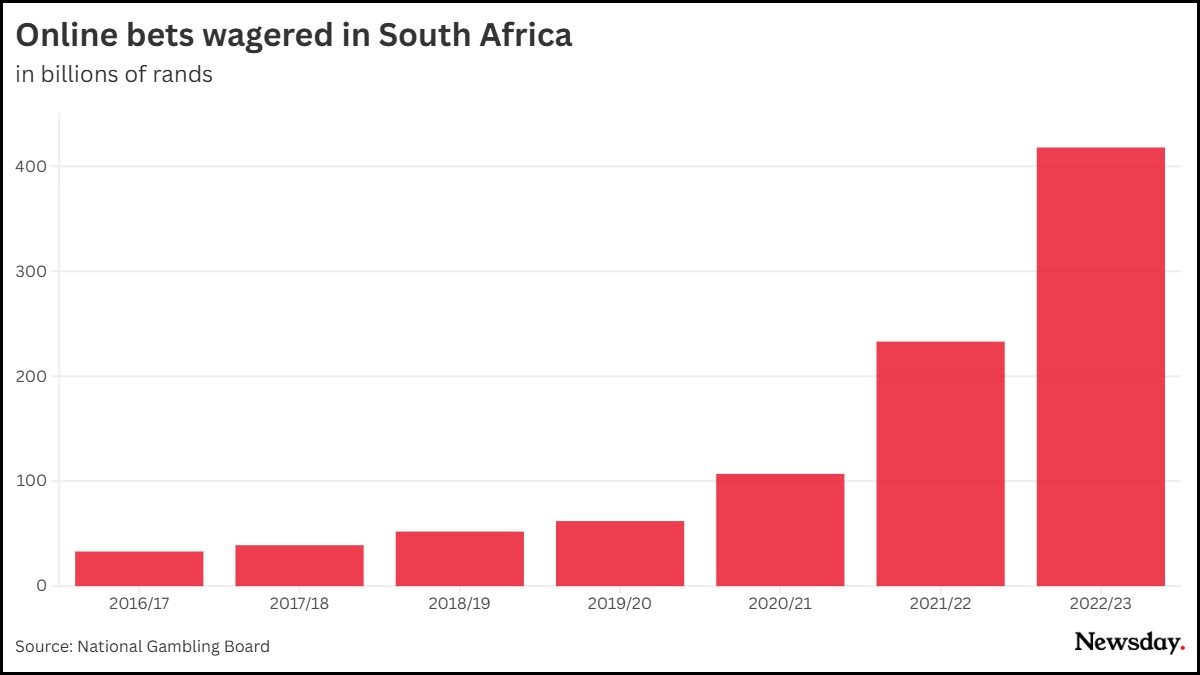
Bets placed by South Africans increased more than tenfold over the seven years between the 2016/17 and 2022/23 financial years.
According to the NGB, South Africans wagered R33 billion through sports betting companies in 2016/17. This increased to R52 billion in 2018/19 and R107 billion in 2020/21.
However, this skyrocketed over the three years, reaching R418 billion by the 2022/23 financial year.
It’s worth noting that these figures show the amount South Africans wager on sports matches, not the amount extracted from the economy.
The money these companies know they will earn from players in the long run is known as the “house edge” or “return to player”, which is a percentage of all money bet.
According to a report by amaBhungane, the “return to player” for online sports betting is around 3%, or R3 for every R100 bet.
Based on this, the betting industry would have earned R36.9 billion in gross gambling revenue. Just under R11 billion of this was generated by Betway, according to financial results.










 Loading ...
It is a plague that betting is now in all sports arenas.
Yet what our doff government banned in advertising is no where near as addictive as betting – and it is iron that Gamblers Anonymous has to pop up at the end of betting apps/adverts: why: because it leads many down the rocky road of incurred debts and people resorting to stealing for the betting “habit”