
Julius Malema’s EFF goes from hero to zero


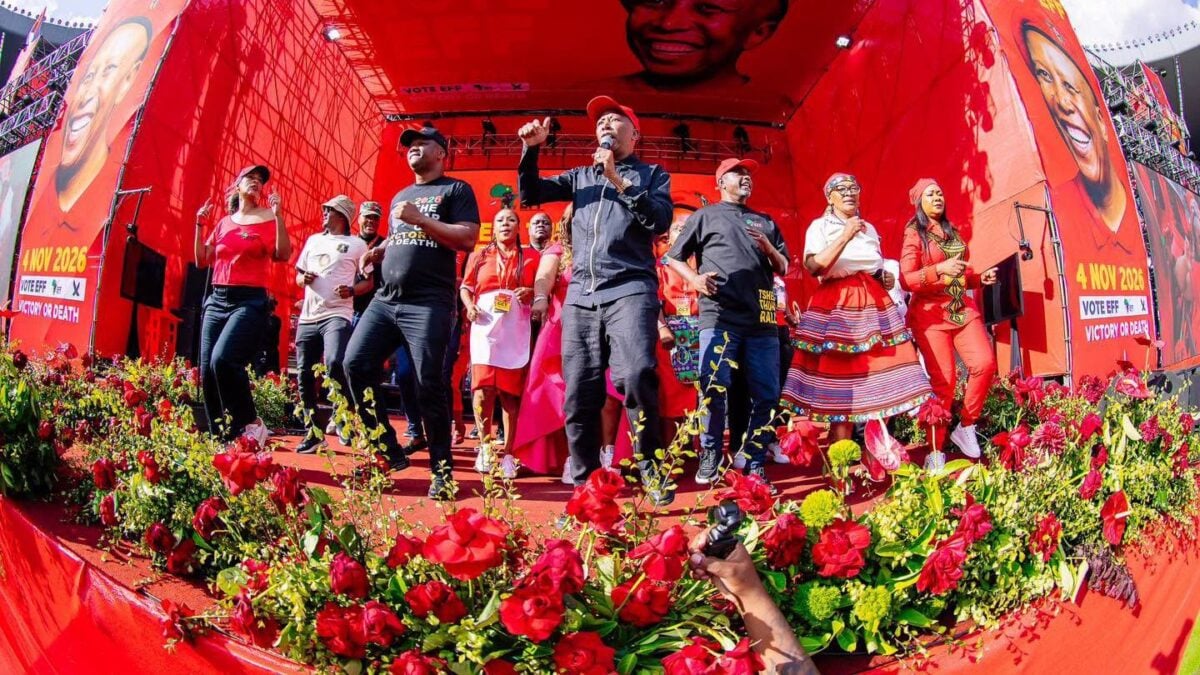
The Economic Freedom Fighters (EFF), led by Julius Malema, have seen a big decline in the 2026 local government elections.
The party experienced its worst results since contesting its first election in the 2014 South African general election on 7 May 2014.
The EFF is a communist and black nationalist political party founded in 2013 by former African National Congress Youth League (ANCYL) president Julius Malema.
It describes itself as a radical, Marxist, Leninist, and Fanonian movement born out of the need to confront the unfinished struggle for true liberation in South Africa.
“The EFF represents the aspirations of the poor, the working class, and the dispossessed,” it states on its website.
At the party’s launch, Malema was flanked by Floyd Shivambu, Mbuyiseni Ndlozi, Andile Mngxitama, and Sam Tshabalala.
Ndlozi said that the EFF project, of which he was a part, predicted a day where the ANC would lose significant support in South Africa.
“If you read it faithfully and with the necessary intellectual honesty, the core of the EFF was to analyse the self-destructive nature of the ANC and SACP,” he said.
“It predicted that a time would come when their electoral support would fall so low that their only remaining option for the ANC would be to move to the right.”
“We therefore created a left-wing entity so that when that day arrived, we could keep the ANC to the left.”
He said that the EFF was founded to serve as an antithesis to the destruction occurring within the heritage of the liberation movement.
With Malema as its leader, the EFF has driven an aggressive pro-black and anti-white agenda, which included chanting ‘Kill the Boer, Kill the Farmer’ at rallies.
It promoted itself as a pro-poor and pro-black party, which attracted many voters who liked its radical rhetoric and big promises.

Julius Malema and the EFF go from hero to zero
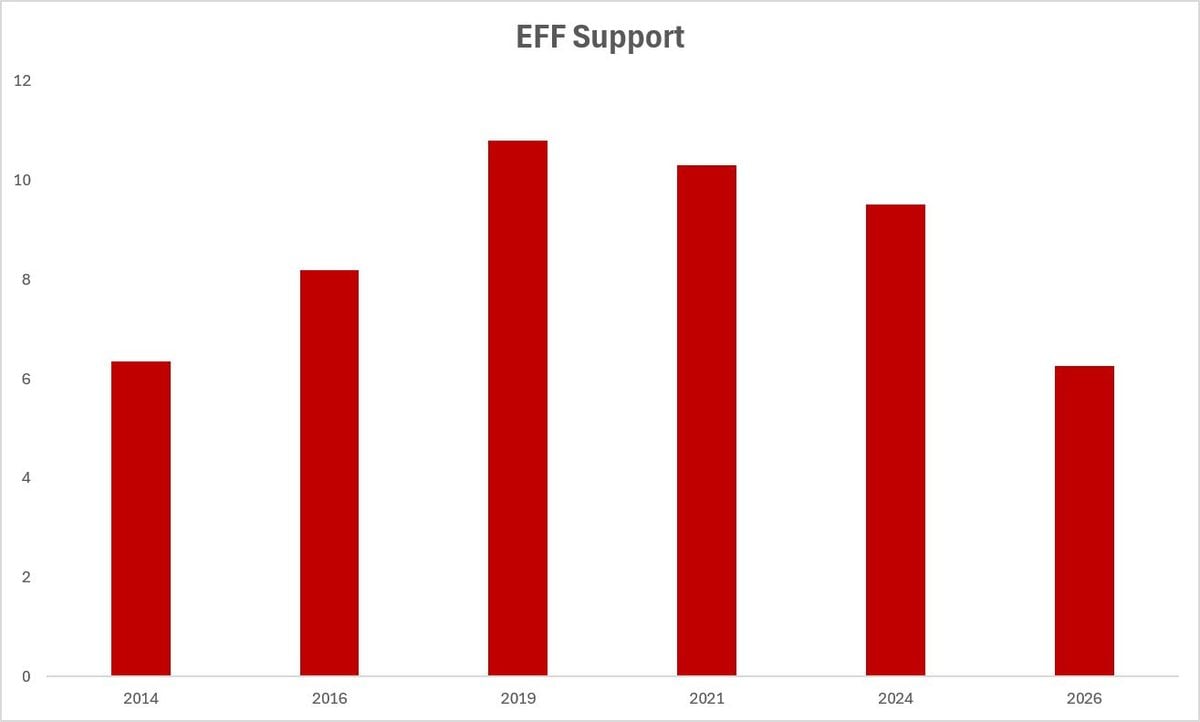
The EFF contested its first election in the 2014 South African general election on 7 May 2014, where it achieved 6.35% of the vote.
Over the next five years, it showed strong growth, with support peaking at 10.80% in the 2019 general elections.
It maintained this support level for the next five years, but in the 2026 local government elections, its share of the vote plummeted to its lowest level in history.
The EFF’s 2026 election campaign used the slogan, Year of Victory or Death, and included the controversial ‘Kill the Boer, Kill the Farmer’ chant.
Malema promised supporters social grants of at least R4,500 per month, free electricity and water to grant recipients, and improved land redistribution to black people.
He said that the EFF would identify unused, abandoned, or state-owned land near urban centres and make it available for free human settlement.
He also promoted jobs insourcing in municipalities and the phasing out of private contractors for municipal functions.
These lofty promises did not resonate with voters, and the EFF attracted only around 6.3% of the vote, its worst performance ever.
It was clear that voters were tired of race politics and unrealistic promises, and were looking for improved service delivery at municipalities and an end to corruption.
Another factor was that Jacob Zuma’s uMkhonto weSizwe Party (MK Party) offered disgruntled ANC supporters another alternative outside of the EFF.
MK Party gained strong support in KwaZulu-Natal, Mpumalanga, and Gauteng, eating into the EFF’s support base.
The chart below shows the EFF’s support from the 2014 general election to the 2026 local government elections.
Julius Malema blames everything but himself
At a media briefing on Saturday, 7 November 2026, Malema offered numerous excuses for the EFF’s poor performance in the 2026 elections.
He said that many black people voted for the white enemy, the Democratic Alliance, which hurt the party.
He also said that his principled refusal to take an anti-immigrant or xenophobic stance against African foreigners in South Africa cost the party votes.
Malema said that he would rather lose electoral support than compromise on African unity or pander to xenophobic sentiments.
Another reason, he said, was the rise of Jacob Zuma’s MK Party, which disrupted the opposition landscape and ate into the EFF’s voter base.
He further blamed former senior leaders for allowing party branch structures to crumble while secretly preparing to defect to rival formations like the MK Party.
Low voter turnout, especially in black townships, was another contributing factor to the EFF’s decline in the elections, he said.
He argued that registered white voters achieved high turnout rates, while young black voters did not show up at the polls.
Malema further pointed to coordinated media attacks, state intelligence interference, and anti-EFF messaging designed to alienate moderate black middle-class voters.
You have read 1 out of 5 free articles. Log in or register for unlimited access.







 Loading ...
I will continue praying you out of existince julius, there is no place for the likes of you and your followers in this world.