
Former allies a threat to collapsing ANC support



The African National Congress (ANC) faces a significant challenge in maintaining support in the upcoming Local Government Elections (LGE).
This is given the threat of Jacob Zuma’s uMkhonto weSizwe (MK) Party and the decision of its longtime alliance partner, the South African Communist Party (SACP), to contest the elections on its own.
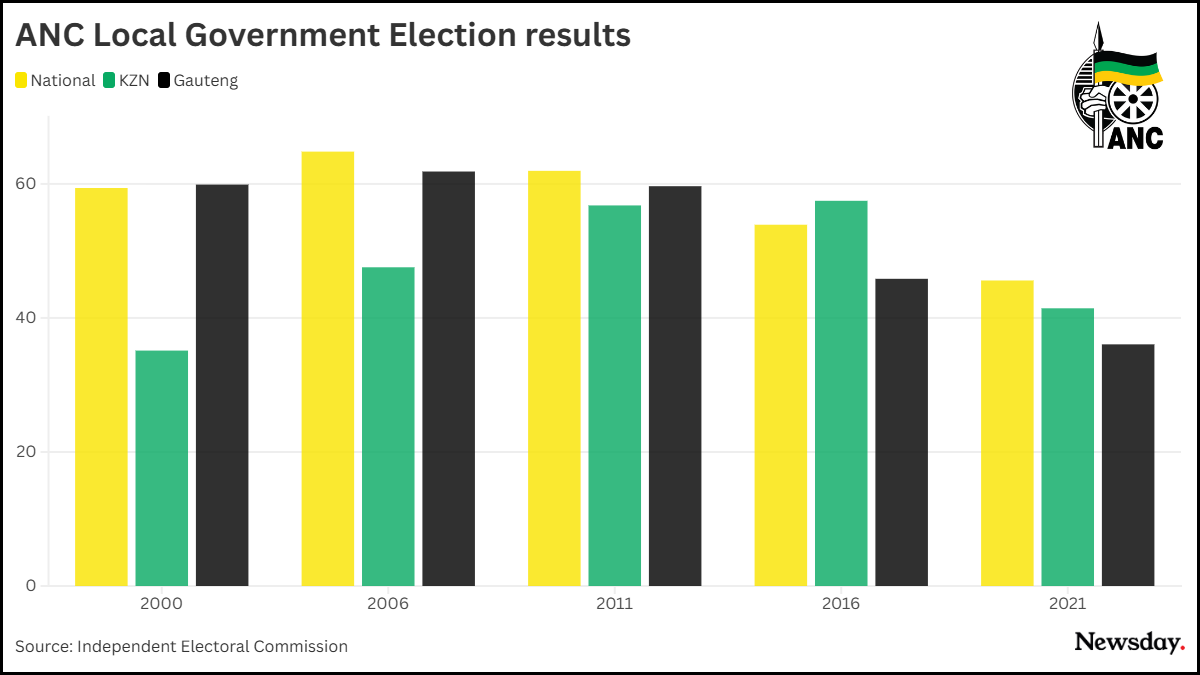
The 2021 LGE was a major sign of the ANC’s dwindling support, achieving 45.6% of support throughout the 213 councils across South Africa, the first time it achieved less than 50% since 1994.
Three years later, the party lost its overall majority in the general elections for the first time, dropping by over 17 percentage points to 40.18%.
The MK Party, founded just six months before the 2024 election, became the country’s third largest party with 14.6% of the votes.
According to Gareth van Onselen, the CEO of Victory Research, KwaZulu-Natal and Gauteng “will be the biggest battlegrounds in the upcoming LGE,” given the MK’s first rodeo in local government elections.
The ANC took the biggest hit in KZN, where the party’s support fell from 55.47% in 2019 to 17.62%.
On the other hand, the MK Party nearly achieved an outright majority by winning 45.93% of the province’s vote.
Van Onselen said that “KZN is going to be fascinating,” as there will be a fierce battle for support in the province. Zuma’s party is likely to take a large chunk of ANC municipal support, like they did provincially.
Like the National Elections, KZN saw a significant drop in ANC support during the 2021 LGE, although not as great, from 57.4% in 2016 to 41.4%.
Gauteng was also a major upset for Cyril Ramaphosa’s party in 2024, where support dropped from 53.2% to 36.5%.
While support for most parties fluctuated by a few percentage points, the MK gained 10% of the vote, making it the fourth-largest party in the province.
ANC support in Gauteng, already below 50% in 2016, dropped by just under 10 percentage points to 36.6% in 2021.
Van Onselen said that while the MK in Gauteng had launched a massive drive about six months ago to capitalise on the 10% it received in the 2024 elections, they have since shifted its focus to KZN.
“I think the MK has realised that KZN is where it lives or dies, and its ability to do well in that province will determine whether it is a lasting force or not.”
He added that for this reason, there is just as much pressure on the MK as on the ANC to do well in KZN.
Another threat to the ANC’s support in the upcoming elections is the announcement that the South African Communist Party (SACP) will be contesting.
This will be the first time that the party will be contesting in an election.
Given that the SACP is part of the Tripartite Alliance, which includes the ANC and Congress of South African Trade Unions (COSATU), its support based would have fallen under the ANC umbrella as this is the only organisation in the alliance to have contested in the country’s democratic elections.
ANC rejects polls suggesting lack of support
Over the weekend, reports of current polling placed the ANC at just 29% support from registered voters nationally.
While polls do not give a definitive picture regarding what would happen if the elections were to be held in the near future, they often are very accurate and gauge voter sentiment at a given time.
However, the ANC has argued that these polls are “designed to sow doubt about the movement’s strength and relevance.”
“Many of these polls are funded by neo-liberal thinktanks and DA-aligned interests to project a manufactured narrative of ANC decline,” it said in a statement on Tuesday.
The party argues that the biggest challenge it faces “is the decline in electoral participation by our people in the democratic processes of our country.”
ANC failure to react to its decline in support

Van Onselen points to the ANC’s inaction to its waning support as something that “constitutes a profound crisis within the party.
“ANC electoral support is, and has been, collapsing, and it is now in a fairly dramatic stage of collapse, as opposed to the first decade, which was slow and gradual,” Gareth van Olsen said.
The ANC saw significant success at the national level for the first three terms that it was in power, steadily increasing its share of seats in the country’s National Assembly.
In the 1994 general elections, the ANC won 62.6% of the vote. Five years later, this increased to 66.3%.
By 2004, reached the height of its reign when it secured more than two-thirds of the vote, 69.7%, under Thabo Mbeki. However, it would only be downhill from there.
The initial decline was slow, dropping to 65.9% under newly elected ANC President Jacob Zuma in 2009 and then to 62.1% in 2014.
The 2019 elections saw the party come the closest it had been to losing its outright majority, when it achieved 57.5% of the vote in the 2019 elections under Cyril Ramaphosa.
However, the party lost more than 17% in 2024, dropping to 40.17% and forcing it into its first-ever coalition in the National Assembly.
“What is striking is how calm and lethargic the party is about it. It is like a man with a gun to his head, perhaps who has even been shot, casually trying to read a novel while medics shout out his vital signs,” van Onselen says.
He describes this lethargy and failure to tend to crises within government, such as crime, unemployment, and education, as almost “sociopathic in its lack of empathy.”
“The party simply doesn’t care what happens in the short term, as it is bound by, in all things, to the long term. It cannot understand that the long term is just a collection of short terms.”








 Loading ...