
The man who lost out to André de Ruyter has a warning about South Africa


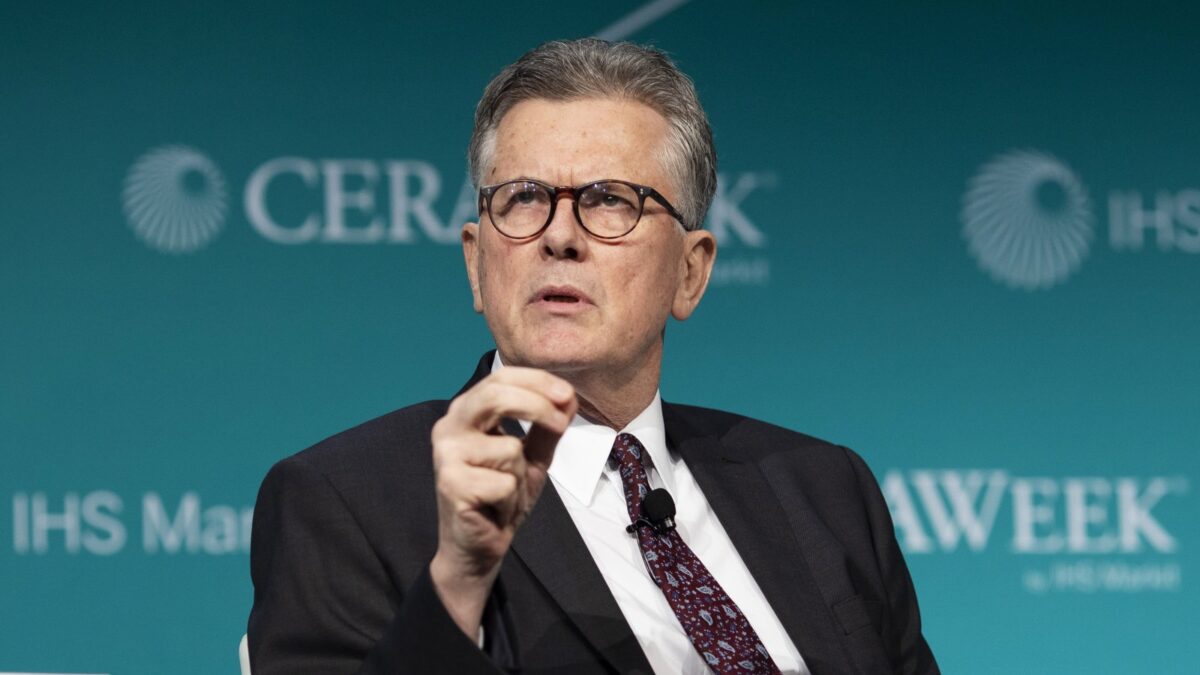
One of South Africa’s top electrical engineering talents has warned that the country faces a skills shortage that threatens to undermine its future energy security.
He has also cautioned against the country moving away from fossil fuels to renewables, arguing that the debate over green and dirty energy is more complex.
Andries “Andy” Calitz is an electrical engineer who has played a significant role in shaping the global liquefied natural gas (LNG) and energy industries.
The career of the Stellenbosch University alumnus spans four decades, starting in 1981 at Eskom, where he served in managerial and executive capacities.
His passion for the energy industry has taken him to dozens of countries, where he has gained an understanding of the dynamics of electrical networks.
He has lived in Cape Town, Johannesburg, Abu Dhabi, Beijing, Boston, London, Lima, Moscow, Perth, Sakhalin, Tokyo, The Hague, and Vancouver.
Calitz was the first Secretary General of the London-based Secretariat of the International Gas Union and is a judge of the S&P Platts Global Energy Awards.
For the first 15 years of his professional career, Calitz worked in electricity generation, planning, industry restructuring, and transmission at Eskom.
When he left the utility to work for Shell in 1996, he was running Eskom’s high-voltage transmission grid.
At Shell, he fostered alliances with energy giants including the Australian Gorgon LNG Project, CNOOC, Gazprom, LNG Shipping, Sakhalin Energy, and SINOPEC.
In 2019, he was among the favourites to take the reins at Eskom after Phakamani Hadebe’s resignation.
The job ultimately went to André de Ruyter, who had 20 years at Sasol under his belt but no experience in the electricity sector.
In a recent interview with BizNews’s Alec Hogg, Calitz said South Africa needed 10 times as many engineers and technicians to build and maintain its future energy grid.
The global energy industry is increasingly shifting away from centralised to distributed generation, with behind-the-meter and microgrid systems taking on a bigger role.
The increased adoption of less stable renewable generation and the ability of prosumers to feed electricity into the grid add to the complexity.
No such thing as clean energy

While Calitz acknowledged the need to reduce emissions, he dispelled the notion that renewables such as solar and wind power are clean.
“There are cleaner and dirtier energies, but there are no clean energies. Every form of energy has an environmental impact,” he said.
“Whether one looks at coal in terms of its mining and air impact on one end or at the other end, the full mining and manufacturing impact of a wind turbine or a solar panel.”
In his view, South Africa will need to unlock domestic and offshore gas, mainly from Mozambique, for “cleaner” peaking generation.
Calitz said his preference for gas over coal was based on three considerations: environmental sustainability, affordability, and security.
When burned directly, LNG produces roughly 50% less carbon dioxide than coal and 20% to 30% less than oil or petroleum products.
It also produces less nitrogen oxides and particulate matter and virtually no sulfur oxides.
In terms of affordability, gas-to-power generation is typically cheaper than coal-based generation.
However, as with other liquid fuels like petrol and diesel, LNG prices can be volatile.
In recent years, gas-reliant nations have been subjected to surging electricity prices due to the Russia-Ukraine and US-Iran conflicts.
Affordability will also be affected by the last consideration, security, which itself will depend on the outcomes of LNG exploration in or around South Africa.
Energy analyst Chris Yelland previously told MyBroadband that the argument for gas-based generation was weakening as lithium-ion battery prices declined.
In many instances, the levelised cost of energy of utility-scale BESS and its long-term cost predictability are making the technology more appealing than gas for peaking plants.
South Africa’s latest energy procurement programme is seeking 5,000MW of gas-to-power generation alongside 4,600MW of BESS.
You have read 1 out of 5 free articles. Log in or register for unlimited access.








 Loading ...