
The ANC is dying, but it should not be celebrated


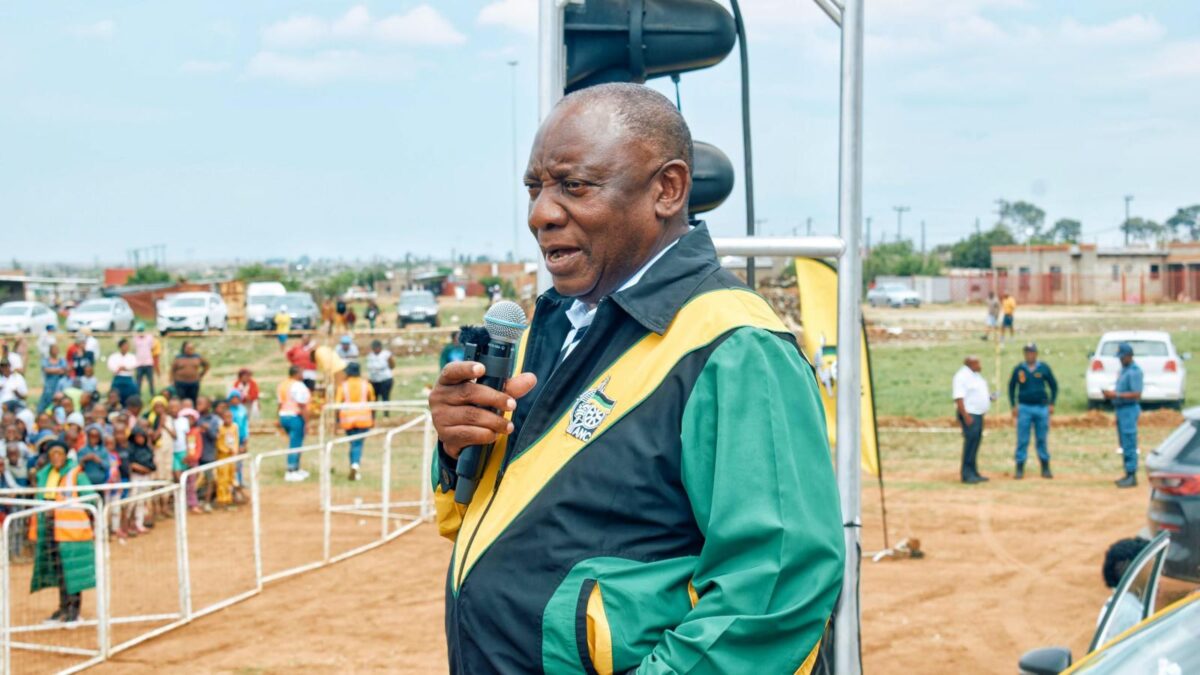
Prof. Vincent Maphai said that the ANC is dying, but that the party’s imminent death is not something to be celebrated.
He shared his views on the African National Congress (ANC) and South African politics during a discussion with the African Renaissance Podcast.
Maphai explained that the National Party and the ANC served as central pillars that held together South Africa’s historical transitions.
However, when a major party dies, as was the case with the National Party, it creates a political vacuum that no single existing party can easily fill.
He said that nature abhors a vacuum, and in the wake of the National Party’s collapse, smaller organisations began to emerge to fill the void.
He explained that the ANC is losing support and authority, and that people are witnessing its collapse.
However, none of the current emerging parties or factions has the capacity to properly fill that void or stabilise the country.
Without a strong party to lead South Africa, the country may experience political fragmentation and chaos rather than greater stability or freedom.
He added that the existence of 500 political parties in South Africa is proof that the political space is fracturing rather than consolidating.
When the centre fails to hold, non-state actors, conservative ethnic groups, and organised criminal elements step in to exploit the breakdown.
This, in turn, results in a lawless environment where democratic rights lose their practical meaning.
That, he said, means that people should not celebrate the ANC’s imminent death, as it can have dire consequences for the country.
Although the ANC can be saved, Maphai said that he does not have faith in the current leadership to do so.
He said that the ANC is effectively leaderless and is failing to lead the country and address national issues.
He added that the current leaders spend far more time fighting among themselves than governing or solving the nation’s pressing problems.
The ANC’s decline

Renowned political strategist and analyst, Frans Cronje, said during a Foord Asset Management webinar that the ANC’s decline is not temporary.
He said that it is part of a long-term structural trend driven by failing public infrastructure, weak economic growth, and deteriorating local governance.
The ANC’s policy framework and reliance on state-driven models have stifled private investment and job creation, eroding its core voter base.
As the ANC loses its absolute majority, power is shifting toward regionalised politics, opposition coalitions, and alternative political movements.
The rise of political parties like the DA, MK Party, and EFF, he said, have permanently altered South Africa’s political landscape.
As state institutions struggle to deliver municipal services and security, communities and private actors are stepping in to perform these functions.
This, in turn, further diminishes the ANC state’s central role and authority and weakens its support base.
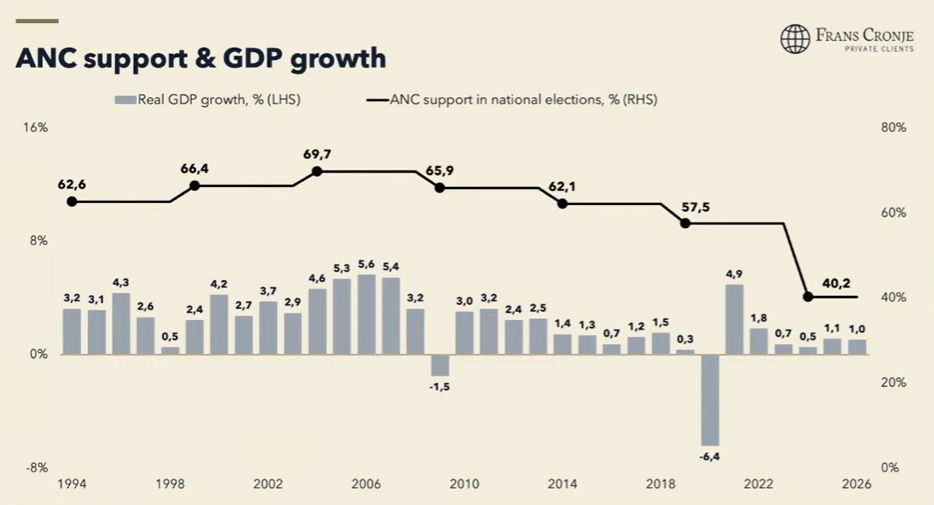
Cronje added that the ANC, as the ruling party in the first 30 years of democracy, was closely tied to economic growth and people’s standard of living.
In the first fifteen years, amid strong economic growth and improving people’s lives, the ANC gained support.
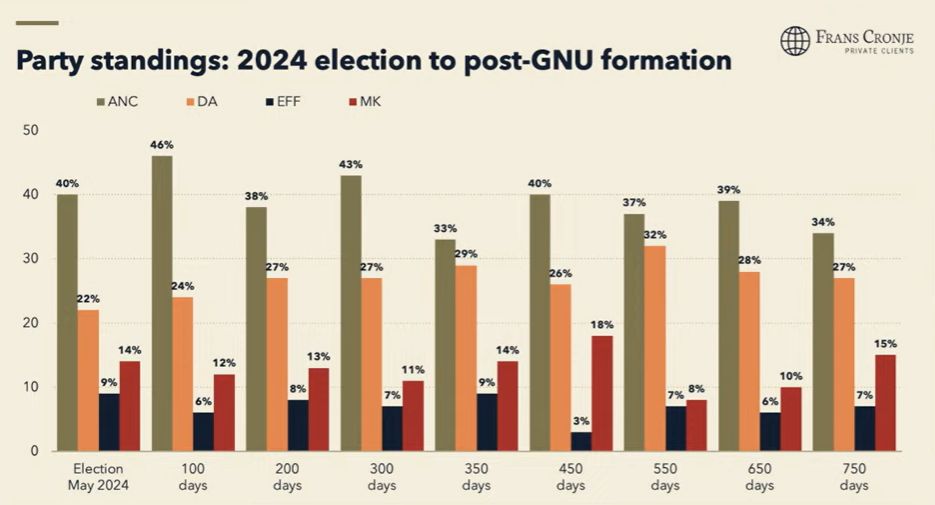
However, over the next fifteen years, the opposite occurred, which saw the ANC rapidly losing support and managing only 40% of the vote in the 2024 general elections.
The charts below, which Cronje shared during his Foord Asset Management presentation, show the ANC’s decline.









 Loading ...
As much as I dislike the ANC, I’m worried about who will replace it. The DA are the obvious choice but there are a lot of EFF and disgruntled ANC people out there who would love to see them fail. My worry is that they will try to sabotage the efforts to rescue South Africa to hide their own inadequacy and corruption. We have some excellent politicians in South Africa and they come from many different parties, we need them all to cooperate and pull together to make a meaningful change to our citizens.