
Beyond survival: Why premature babies need more than just lifesaving care


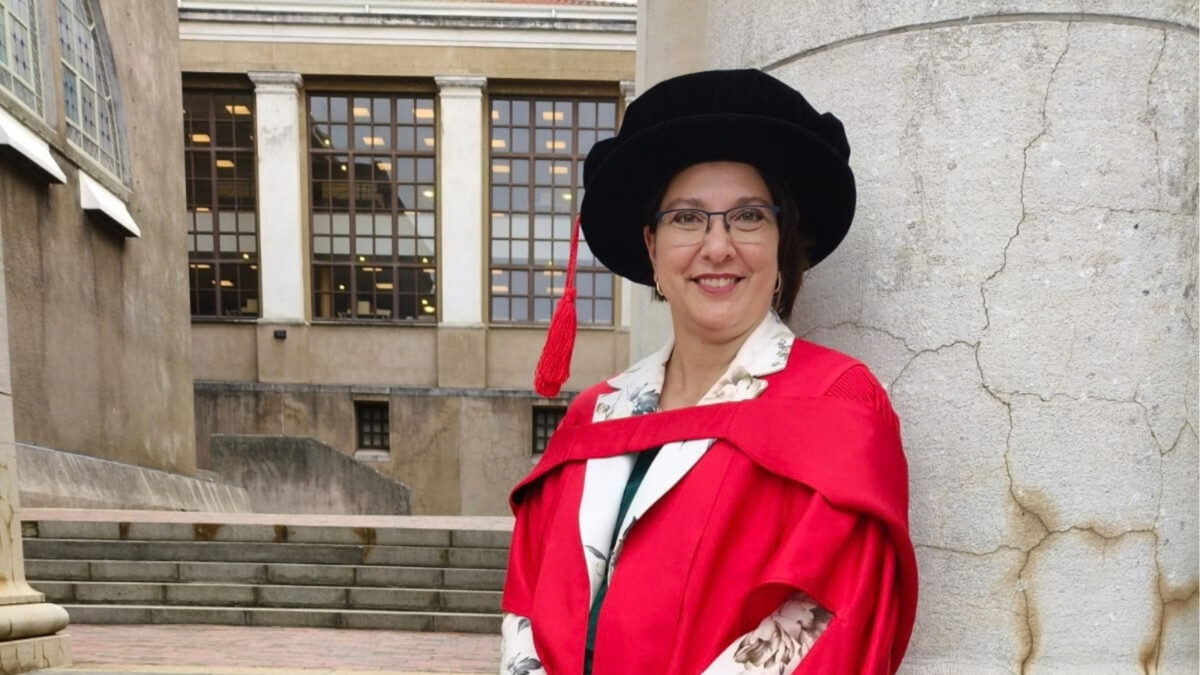
Prof. Welma Lubbe, professor at the North-West University’s (NWU) Faculty of Health Sciences
For a premature baby, surviving the neonatal intensive care unit is a first victory – but it is only the beginning.
For a tiny human born too soon, those weeks in neonatal care are about far more than survival, says Prof. Welma Lubbe, professor at the North-West University’s (NWU) Faculty of Health Sciences.
“The neonatal unit is not a neutral waiting room while a baby grows,” she says. “Every sound, light, touch, and handling either supports that developing brain or adds stress to it.”
That need to protect development as well as survival lies at the heart of the NWU’s INDeSC project – the Implementation of Neurodevelopmental Supportive Care – which helps neonatal units across South Africa make developmental care part of everyday practice.
Because a premature baby’s brain is still developing outside the womb, early stress can affect a baby’s body straight away – heart rate, breathing, oxygen levels and feeding – as well as longer-term development, such as movement, learning, attention, language, hearing, vision and later school readiness.
Yet developmental care can easily be overlooked when survival is the immediate priority.
“When the focus is on survival, developmental care is often mistaken for a nice-to-have rather than core treatment,” says Prof. Lubbe. “But it is not the icing on the cake; it is the eggs that keep the cake together.”
That is where neurodevelopmental supportive care, or NDSC, comes in.
Turning evidence into practice
NDSC means caring for a premature baby in a way that lowers stress, protects the developing brain, and works with the baby’s maturity, Prof. Lubbe explains.
At the bedside, this can mean dimming lights, lowering voices, supporting curled positioning, protecting sleep, easing pain and stress, encouraging kangaroo care, and welcoming parents as partners.
“Small things, done consistently, that add up to a very different start in life,” says Prof. Lubbe.
These elements should work as one connected model, not isolated interventions: positioning, feeding, sleep, pain, stress and the sensory environment all affect one another.
Treating NDSC as a connected model also changes the culture of a neonatal unit, helping the whole team – including parents – see the baby as a developing person rather than a collection of separate tasks.
INDeSC works with public and private neonatal units across South Africa to turn decades of evidence into everyday practice at every cot, on every shift.
Rather than delivering once-off training, INDeSC partners with units over time to examine routines, identify what works, appoint a local champion and mentor teams as they take ownership.
“It is a partnership over time, with the unit in the driving seat, rather than a programme done to them,” Prof. Lubbe says.
Run through the NWU’s Faculty of Health Sciences within NuMIQ (Quality in Nursing and Midwifery), the project has been running as a multi-site implementation project since 2018.
The project follows a six-stage journey from awareness and adoption to ownership, early evidence, routine integration, and sustainability after the research team steps back.
Staff shortages, heavy workloads, limited resources, staff rotation, and competing priorities can all make change difficult. Developmental care may be seen as extra work, or as someone else’s responsibility.
“The gap is rarely about willingness – it is about the leadership, support, and structure needed to make the best, evidence-based way the normal way,” Prof. Lubbe says.
Because a premature baby is cared for by nurses, doctors, therapists, dietitians, social workers and parents, INDeSC helps create a shared language and ownership of care.
“If they are not working from the same understanding, the baby gets mixed messages: one person creates calm and the next undoes it,” Prof. Lubbe explains.
A multidisciplinary approach
Parents are central to this approach.
“They are part of the treatment,” Prof. Lubbe says.
Their voice, smell, touch, and skin-to-skin contact can help regulate their baby’s heart rate, breathing, temperature, and stress.
Meaningfully involving parents means welcoming them around the clock, teaching them to read their baby’s cues, involving them in everyday care, and treating them as the constant in their child’s life.
“We need to prepare parents for their parenting journey as much as we need to support preterm babies to survive and thrive after their early start,” Prof. Lubbe says.
This philosophy also drives Little Steps, South Africa’s first evidence-based support organisation for parents of premature babies founded by Prof. Lubbe. It later expanded into professional training and research to help hospital teams change practice and culture.
Prof. Lubbe’s second PhD, in paediatric neuroscience at the University of Cape Town, has added another dimension to her work.
Neuroscience helped her understand the “why”: what stress, pain, noise, and separation do to developing baby and parent brains, and how protective care can change that.
“It has strengthened my conviction that developmental care is not soft or optional; it is neuroprotection,” Prof. Lubbe says.
That understanding is informing the NWU’s planned postgraduate programmes, which aim to train healthcare professionals in what to do, how to do it, and why it matters.
In the current INDeSC research, that same focus is measured in practice change first: a womb-like environment, better positioning and handling, pain management, and parent presence. It also tracks outcomes such as stability, feeding, weight gain, hospital stay, parent stress, and satisfaction.
Ultimately, the aim is to see fewer developmental difficulties, children who do better at home and at school, and whether changes last after the research team steps back.
“Because care that is not sustainable has not really been implemented at all,” Prof. Lubbe says.
For INDeSC, success means developmental care is no longer a special project, but simply how neonatal care is delivered across South Africa – with parents as partners, teams working around each baby’s development, and babies given the best chance not only to survive, but to thrive.
“In short, all care is brain care,” Prof. Lubbe says. “If we protect infant brains today, we will have thriving children and societies tomorrow.”










 Loading ...