
Helen Zille’s stark warning: Johannesburg’s race against time to reverse its decline



Johannesburg faces a deepening crisis of failing infrastructure, financial strain and political instability.
Democratic Alliance (DA) City of Johannesburg Mayoral candidate Helen Zille warned that the upcoming local elections may be the city’s “last chance” to reverse its decline.
In a State of the Nation podcast, Helen Zille weighed in on Johannesburg’s current state and its precarious future.
The discussion opened by highlighting Johannesburg’s dire reality, painting the picture of a municipality where service-delivery failures are systemic rather than isolated.
Three decades of neglected maintenance have left roads, electricity infrastructure and water networks fragile.
Compounding this fragility are the financial pressures facing municipal utilities. City Power’s monthly customer revenue is lower than the amount Johannesburg owes Eskom.
This has left the utility drowning in debt and constrained its ability to maintain and upgrade critical infrastructure.
Water, another of Johannesburg’s essential utilities, paints a similarly depressing picture, with 22 collapsing water systems.
The consequences extend beyond basic utilities as municipal clinics face failures in basics like laundry services and specialist medical-waste removal.
The severity of the crisis has prompted unprecedented national intervention. The Minister of Finance, Enoch Godongwana, recently withheld funding from 60 municipalities.
Johannesburg was among the flagged municipalities, with funding withheld over unauthorised, irregular, fruitless and wasteful expenditure.
But service delivery failures are not the only problems plaguing Joburg municipality. Corruption and political deal-making are also rampant.
Zille described this period as “the last lap of looting”, a phase where remaining municipal resources are being stripped ahead of the next local election.
For example, a R2.2 million estimate to refurbish Proton House was replaced by a R24 million quote, an increase that is more than tenfold the initial estimate.
The contract was reportedly given to a firm with political connections and a limited track record.
Turning to the instability of the coalition government, Zille highlighted that over the past 10 years Johannesburg has had 10 mayors.
The continual change in leadership makes effective governance difficult, leaving parties vulnerable to political bargaining and pressure.
As she put it: “You always have to choose the least bad option. There’s never a good option for a coalition.”
She explained that coalition governments are “always incredibly difficult to manage and you get held to ransom, and you get extorted.”
The leadership crisis can be seen in the deterioration of the city’s infrastructure, with essential structures being stripped for scrap.
In Fietas, for example, structural metal is being removed from old railway bridges, making these structures unsafe.
Against this backdrop, the DA’s objective in the upcoming local government elections is to secure a “50% plus one” outright majority.
This would allow it to establish a stable five-year administration without relying on shifting coalition agreements.
The DA’s route to recovery
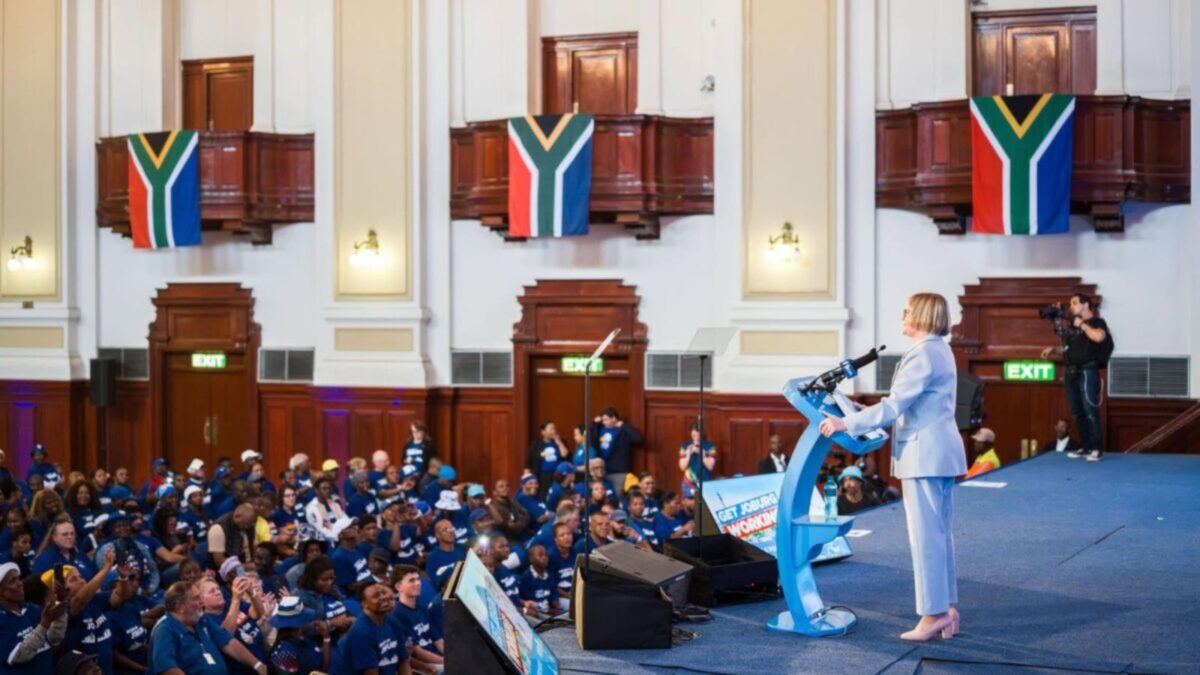
Zille outlined a turnaround strategy.
The aim is get to the core of the problem. She wants to fix the underlying institutional and financial weaknesses that have contributed to Johannesburg’s decline.
The proposed approach includes forensic audits, reforming the city’s billing system, and working with civil society, National Treasury and the Presidency’s Operation Vulindlela.
The broader objective is to strengthen the city’s finances, infrastructure and ability to deliver basic services.
For Zille, the success of such a recovery pivots on the outcome of the November elections.
The DA estimated that 490,000 votes is the magic number they need.
The aim is to secure an outright majority so they can easily push through their policies. Such a result would mean the party can establish a stable administration without relying on coalition politics.
Against this backdrop, Zille issued her starkest warning. Johannesburg has reached a critical point and the opportunity for recovery is diminishing rapidly.
“Things are so bad that this might well be the last chance we have of turning things around,” she said.





 Loading ...
I’m rooting for you girl, you will get the job done, go for it and I hope you get the more then the 50 plus one. You richly deserve the job and won’t fail the people.