
One man warned about South Africa’s water crisis 18 years ago – and was suspended



Dr. Anthony Turton warned 18 years ago that South Africa is facing a water crisis, which can lead to public anger and social unrest. This is now playing out in real time.
In November 2008, Turton published a paper, “Three Strategic Water Quality Challenges that Decision-Makers Need to Know About and How the CSIR Should Respond.”
In this paper, he warned that South Africa was facing a critical water crisis characterized by a growing ingenuity gap.
He argues that while demand for complex technological solutions was growing exponentially, the country’s capacity to develop them was declining.
He explained that South Africa has already allocated approximately 98% of its national water resource and that it effectively has no more surplus water.
Because there is no surplus water available for dilution, all pollutants and effluent must be treated to much higher standards before discharge.
Unlike most global cities located on major rivers or coasts, South Africa’s major economic hubs, such as Johannesburg and Pretoria, are situated on watershed divides.
Because these cities are at the top of the watershed, their treated and untreated effluent flows downstream, degrading water quality.
Another problem was that South Africa was struggling with its national science, engineering, and technology (SET) capacity.
Turton warns that the country was flying blind because it was losing the experts needed to solve uniquely South African water problems.
He warned that if the government fails to deliver essential services, such as clean water, there is a high risk of social unrest.
He added that unresolved water constraints could lead to “anarchy and chaos” as social instability grows.
Turton urged the government to avert the water crisis before it happens. The alternative was to deal with the fallout, as was the case with load-shedding.
Instead of taking his threat seriously, his employer, the Council for Scientific and Industrial Research (CSIR), suspended him.
The council executive of the CSIR charged the water scientist with insubordination and bringing the CSIR into disrepute.
Turton’s water crisis warning in Gauteng
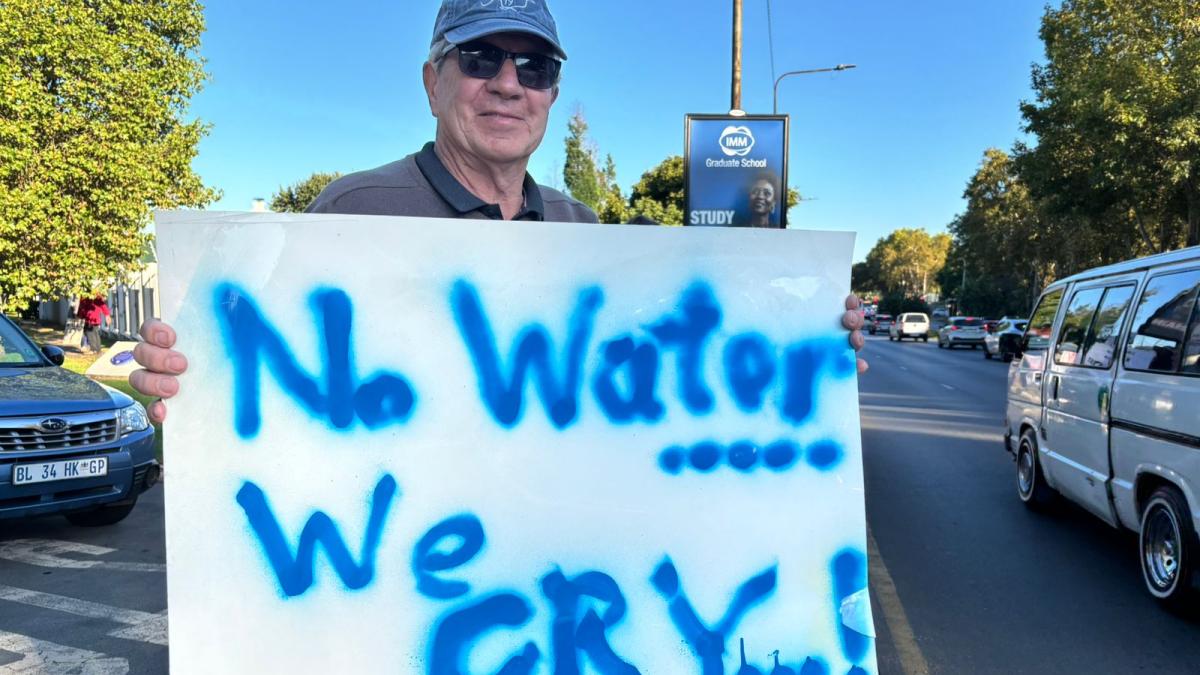
Apart from his warning in 2008, Turton has more recently sounded the alarm that the system in Gauteng would start to self-destruct.
He has frequently criticized Rand Water’s management, stating that it is pumping more water into a leaking sieve.
These comments referred to municipal infrastructure losses of up to 50%, which leads to reservoir depletion.
He highlighted that Johannesburg Water loses roughly 44% to 50% of its water to leaks and theft before it reaches customers
Turton’s warnings regarding Gauteng have intensified significantly between 2024 and 2026 as the crisis started to unfold.
He described the province as the epicenter of a national crisis, frequently using the term water-shedding to describe what he called the new normal.
In early 2025, he described the collapse of Wastewater Treatment Works (WWTWs) as national suicide, poisoning its own drinking and crop-production water.
Turton has been an outspoken proponent that water is not just a utility, but a foundation of the national economy.
He warns that water-shedding, unlike load-shedding, cannot be easily mitigated by the private sector and will lead to capital flight.
He argued that the water boards, like Rand Water, are being pushed into a death spiral because municipalities owe them billions.
However, they lack the technical acumen to fix the billing and infrastructure issues that would generate the revenue to pay those debts.
He warned that as formal water systems fail, water tanker mafias take root. These are parasitic structures that thrive on state failure.
Once established, they are nearly impossible to dislodge because they have a vested interest in the taps staying dry.





 Loading ...
When do we accept that a system is finally dying?
As much as this will probably piss on the people of JHB batteries, the reality of the situation is that corruption has done it’s job that side. The water problem is merely a symptom of deeper social political problems.
We have all heard the term “Transformation.” This is entrenched in the ANC policy document on the National Democratic Revolution. This is exactly what they intended when transforming society.
They have transformed Rand Water from a functioning reputable arm of government to a tool that delivers oppression to everyone equally.
If you think they are embarrassed or feel guilty they don’t, they are a political organisation based on Marxist beliefs. Their mindset is that of the oppressed vs the oppressors. They do not have a winning mindset rather a losing one. So don’t be surprised when you get loser-like results.
My suggestion is to become self-reliant, as we have done in many communities, collect water in tanks via rain and when the water comes on(I collect 10000 litres and cut myself off from municipal water saving some cash). Save this water and use it sparingly. Then work on voting these people out, they do not care for your children, the country or any of their so called comrades. As elections approach, you will find these so called comrades fragment and start fighting amongst themselves.
You simply can not Love God and Karl Marx. These ideas do not align. And God will not bless a corrupt organisation, so get ready, if you really want change remember that the way to it is via the ballot box. You will have an opportunity sooner than you think.