
Organised criminal syndicates behind Johannesburg’s hijacked building crisis – Morero


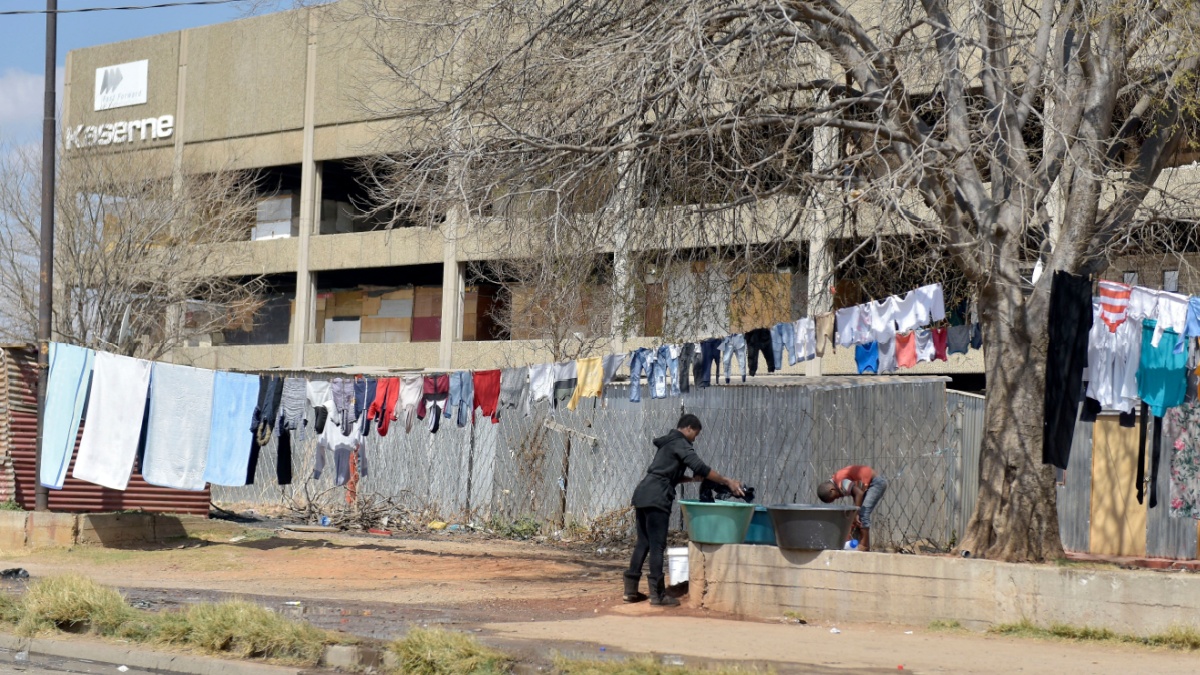
Johannesburg Executive Mayor Dada Morero has blamed organised criminal syndicates for driving the city’s escalating hijacked building crisis, arguing that powerful networks are making it nearly impossible to reclaim and redevelop inner-city properties.
Speaking in an interview with the SABC, Morero described the occupation of buildings as a coordinated criminal enterprise rather than a problem rooted mainly in homelessness.
He has called for stronger intervention from the South African Police Service (SAPS), saying “huge syndicates” are behind the takeover of buildings across the inner city.
According to the Mayor, the influence of these groups means that even successful renovations are unlikely to hold.
He warned that without dismantling syndicates, hijacked buildings will continue to be reclaimed by criminals even after redevelopment.
“You can buy a building today, renovate, get the right tenants… you’ll be lucky if in the next 3, 4, 5 years it is not hijacked,” Morero said.
City audits have identified at least 188 hijacked buildings, although police data and academic research suggest the broader number of derelict and partially hijacked properties may be between 200 and 300.
These sites have increasingly been linked to crime, unsafe living conditions and the illegal connection and theft of basic services.
Morero has also pointed to legal constraints as a major obstacle, citing Constitutional Court rulings that require municipalities to provide Temporary Emergency Accommodation (TEA) before evictions can take place.
“It is a Constitutional Court judgment… implies once you evacuate and remove people from a building, you must provide alternative accommodation,” he said, adding that the City is exploring legal avenues to navigate the requirement.
Court records and municipal data indicate that the TEA obligation has become a central stumbling block for the City.
Officials have acknowledged that Johannesburg has “insufficient alternative accommodation available” and that there is no dedicated municipal budget for relocating residents.
As a result, court orders to evacuate unsafe buildings such as Vannin Court, Casa Mia and Wimbledon have not been carried out, largely because the City has nowhere to move occupants.
The uphill fight

Despite Morero’s public claims of “taking back control” and obtaining “over 10 court orders” in late 2025, available documentation suggests limited progress.
The City has provided evidence for seven court orders, but the Daily Maverick reports that four of those buildings remain occupied and in unsafe conditions.
Only one building, Remington Court, has reportedly moved from eviction to redevelopment. It was converted into student accommodation by a private developer in October 2024.
Other buildings cited as successes, including Delvers and Moth, were evacuated and secured, but remain vacant without confirmed redevelopment plans or budget allocations.
The City’s challenges are reflected in the case of Vannin Court, once linked to a proposed R45-million regeneration project announced in 2017.
That deal later collapsed, and the building remains hijacked, structurally compromised and widely regarded as a criminal hideout.
The crisis has been further complicated by the approach taken by MMC for Public Safety, Mgcini Tshwaku, according to reports.
Following several high-profile crimes linked to hijacked buildings, including the murder of DJ Warras, Tshwaku has been filmed engaging directly with building occupants in what has been described as “negotiations” to reclaim properties.
ActionSA has criticised the approach and petitioned the Gauteng Premier to intervene, arguing that negotiating with occupants may bypass the Prevention of Illegal Eviction (PIE) Act.
The party has warned that such engagements risk legitimising unlawful control and creating the impression that executive action can replace judicial processes.
Analysts have also pointed to a lack of reliable intelligence as a key weakness in the City’s response.
Lusanda Netshitenzhe from the Presidential Task Team on hijacked buildings has said the municipality lacks a comprehensive social audit of who is living in these properties.
Without clearer data on whether occupants are undocumented foreign nationals, indigent South Africans or working families exploited by slumlords, the City faces difficulties in designing lawful interventions or motivating for additional funding from the National Treasury.
“We cannot fix what we don’t know,” Netshitenzhe said, noting that private sector partners are reluctant to commit to redevelopment projects until buildings are fully vacated.










 Loading ...
But the whole of Southafrica knows that . The question is , what is the mayor gonna do about it ?