
South Africa could have over 500 registered political parties



The Electoral Commission (IEC) has received applications for the formal registration of five new political parties, which if all are successful, would lead to 501 registered parties in South Africa.
These notices, published in a 30 January 2026 government gazette, serve as a public announcement allowing citizens to view the intended names, abbreviations, and logos of new political entrants.
Looking at the parties that applied, these include:
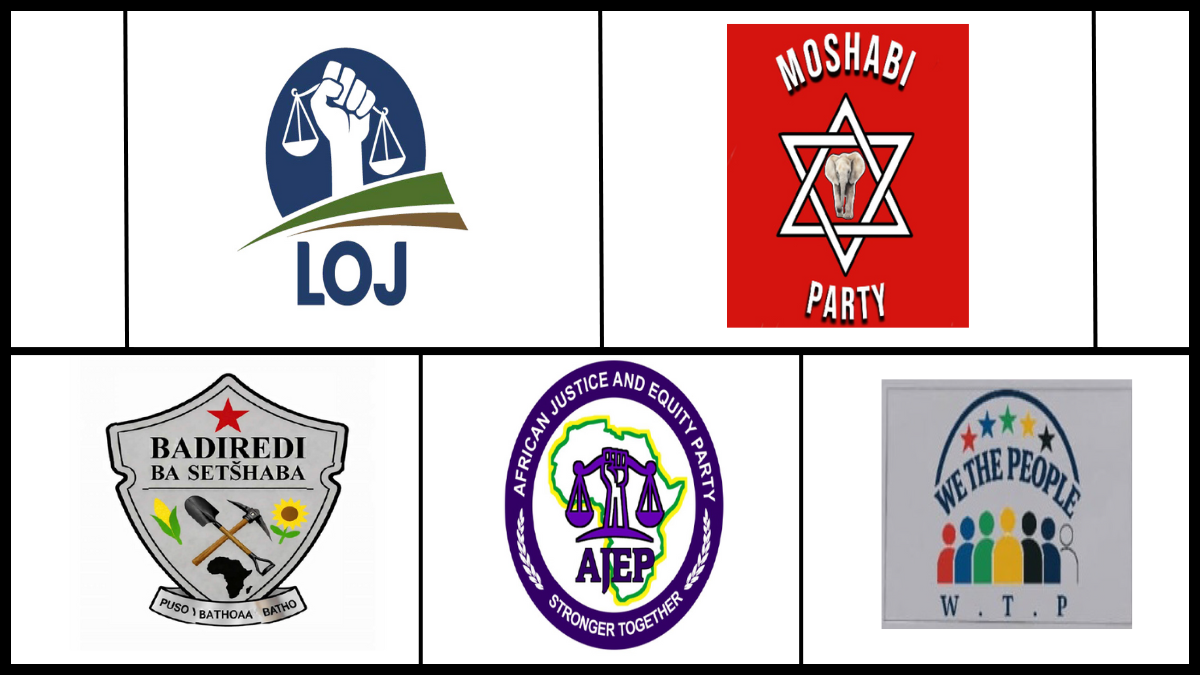
- Law, Order and Justice (LOJ) submitted its application on 27 January 2026, with a symbol showing a raised fist holding the scales of justice.
- Badiredi Ba Setšhaba (BBS) applied on 30 January 2026, with its logo showing a shield containing a shovel, pickaxe, maize and sunflower, suggesting a labour or agriculture focus.
- We The People (WTP), listing a business address in Boksburg, uses a logo of multicoloured silhouettes grouped beneath the party name.
- The Moshabi Party submitted its application on 26 December 2025, uses the abbreviation “MOSHABI”, and features an elephant inside a six-pointed star.
- African Justice and Equity Party (AJEP), with its submission dated 13 November 2025, has a logo depicting scales of justice over a map of Africa.
The publication of these notices initiates a specific objection period.
For the five organisations seeking new registration, members of the public wishing to object must submit a written notice to the Chief Electoral Officer setting out their grounds within fourteen days of the Gazette’s publication.
In addition to the five new applications for registration, the Gazette details applications from existing parties seeking to significantly alter their identities:
- The Mayibuye People Movement has applied to change its name to the Service Delivery Party (SDP), accompanied by a new “thumbs up” logo featuring the colors of the South African flag.
- The African Nationalists (AN) have applied to change their name to the Randwest Peoples Party (RPP), adopting a new floral logo that is similar to that of the G20 logo.
South Africa’s record-number of registered parties
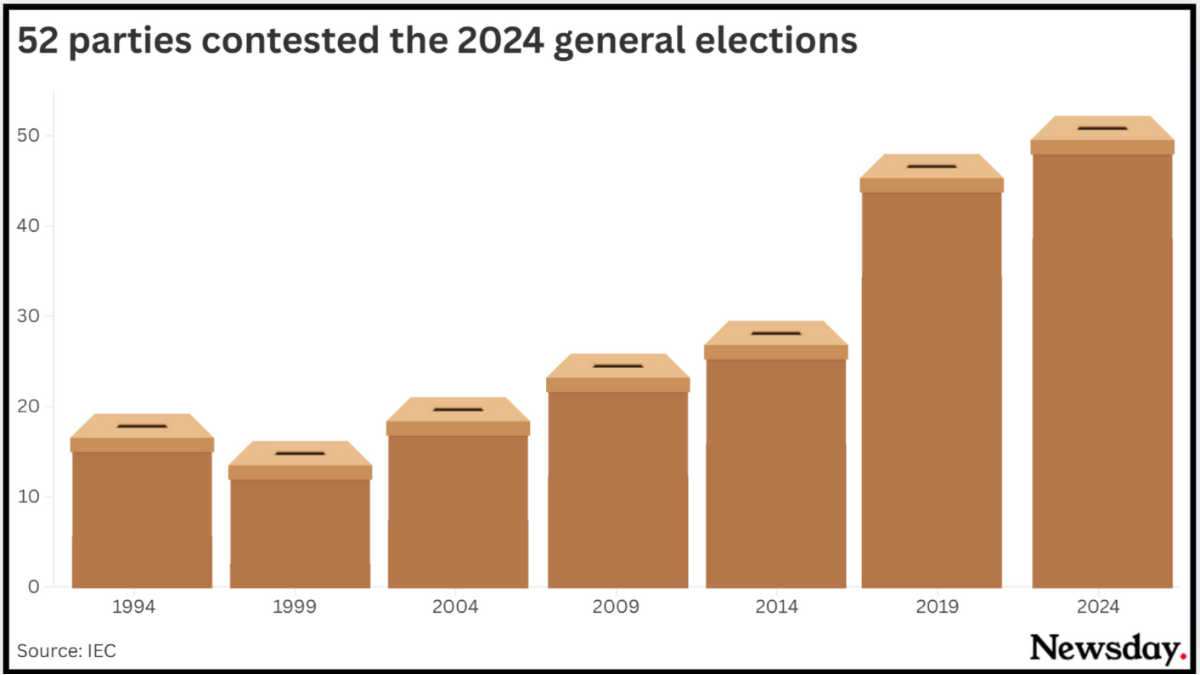
In the 2024 general elections, a record number of 52 political parties contested the national ballot. Eighteen parties ultimately got representation in the National Assembly, up from 14 in the previous term.
Experts say that the large number of parties in South Africa is complex, reflecting the country’s history, diversity, and electoral rules.
After apartheid ended in 1994, the Constitution deliberately created a highly inclusive political system, lowering barriers for groups to organise politically.
The proportional representation system, which allocates seats based on vote share, allows even small parties to win seats.
Combined with South Africa’s ethnic, linguistic, and cultural diversity, this has encouraged the rise of regional and niche parties.
Frustration with dominant parties has also fueled fragmentation, with many splinter groups from larger parties creating new movements.
Registering a party requires just 1,000 signatures and a modest fee, making it easy for small groups to enter politics.
Professor Susan Booysen, a political analyst and professor at the University of the Witwatersrand, wrote that “the proportional representation system, combined with the low threshold for forming a party, allows for a multiplicity of voices.”
However, “it also fragments the political landscape, often reflecting deep-seated social and ideological divisions.”
Not all political parties contest the ballot, and many struggle to gain enough support to be represented, or be on the ballot at all.
How parties register and get on the ballot
Registering a political party in South Africa requires compliance with specific procedures that vary depending on the level of registration: national, provincial, or metropolitan/district.
At the national level, applicants must complete and submit the official application form, a copy of the party’s constitution and a Deed of Foundation signed by 1,000 registered voters in support of its establishment.
A R5,000 registration fee must then be paid and then the party is registered with the IEC.
For provincial level registration, the process mirrors the national requirements but with slightly lower thresholds. Instead of 1,000 signatures, 500 registered voters must sign, and the registration fee is R3,000.
At the metropolitan or district level, the requirements remain largely the same: 300 signatures from registered voters and a R2,000 registration. National and provincial registrations are Gazetted, but the metro/district is not.
According to the Electoral Commission Act, a party that is not represented in any sphere of government must renew their registration.
Being registered does not mean the party will be on the ballot. South Africa holds national, provincial, and local elections with different rules for parties and independents to register.
National elections fill 400 National Assembly seats: 200 proportional and 200 regional. Parties must register with the IEC, submit documents, voter signatures, and pay deposits, which was R300,000 for all National Assembly ballots in 2024.
Provincial legislatures are elected proportionally, with parties paying a deposit of R50,000 per province; independents need 1,000 signatures.
Local government elections use ward and proportional seats. Parties nominate ward and PR candidates, while independents contest wards only, needing 50–100 signatures and small deposits.
The IEC said that it will convene a series of information sessions starting in November 2025 with registered but unrepresented political parties and aspiring independent candidates in preparation for the upcoming elections.



 Loading ...
Registration should be much higher and that would eliminate a lot of small parties that will never amount to anything!