
How to keep Johannesburg’s finances away from sticky fingers



Ringfencing municipal finances is critical if Johannesburg is to arrest the collapse of basic services, according to Democratic Alliance (DA) mayoral candidate Helen Zille.
She argues that residents are paying for water, electricity and sanitation without seeing corresponding improvements on the ground.
In an interview with Newsday, Zille said Johannesburg’s financial practices have allowed revenue collected for essential services to be diverted elsewhere, hollowing out infrastructure and accelerating service delivery failures.
The Auditor General’s most recent report found that the municipality disclosed spending of R228.76 million on repairing and maintaining property, plant and equipment.
This is equivalent to 0.5% of the value of property, plant and equipment, well below the National Treasury norm of a minimum 8%.
Their R89.4 billion annual budget has long been plagued by sticky fingers and inefficiency without sufficient oversight of the finances.
For example, in January 2026, the city council approved writing off R868 million in fruitless, wasteful and irregular expenditure.
Zille said that ringfencing, the legal separation of funds so they can only be used for their intended purpose, is a needed practical governance tool rather than an ideological stance.
“People pay for water in the city of Johannesburg,” Zille said. “The money that gets paid for water must primarily be used to provide clean, reliable water.”
She said the collapse of water and wastewater systems was the predictable result of decades of neglect, pointing to chronic underinvestment in maintenance as a central cause.
“The simple reason for that is that there has been very little maintenance for 30 years,” she said. “If you don’t maintain a system, it breaks down.”
According to Zille, money intended for water infrastructure has repeatedly been redirected to other municipal priorities, masking the true cost of underinvestment until systems fail outright.
“That money gets swept out of the water account and used on all kinds of other projects,” she said, adding that infrastructure collapse is then treated as an unforeseen crisis rather than the outcome of long-term financial mismanagement.
Zille said ringfencing finances is essential to restoring both services and public trust, particularly in a city where residents are increasingly reluctant to pay for utilities that do not function reliably.
She argued that visible improvements are key to reversing non-payment and stabilising municipal finances.
“If people pay for a service, they must get that service,” she said, warning that failure to deliver erodes the social contract between residents and local government.
Water must be a priority
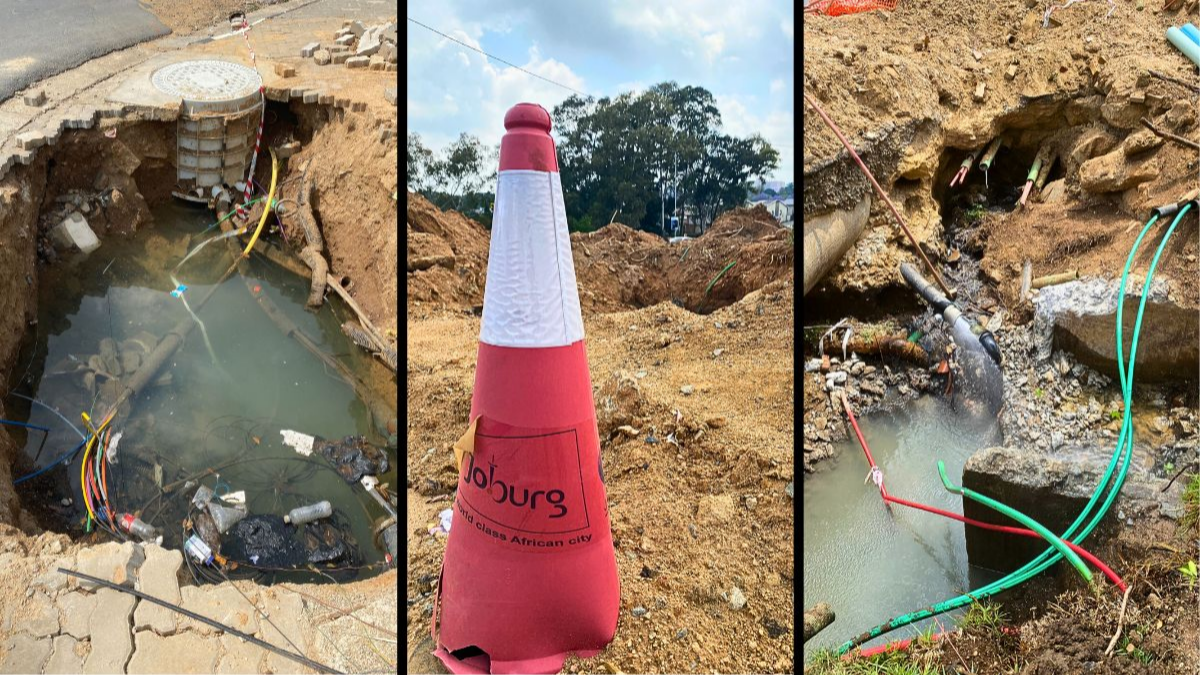
She said water should be treated as Johannesburg’s most urgent priority, given its central role in public health, economic activity and environmental protection.
“Water is the top priority in the city at the moment,” Zille said. “We must use that money primarily for water.”
Zille also linked ringfencing to accountability, arguing that clearer financial boundaries would make it easier to track spending and identify where systems are breaking down.
“The more transparency we get, the more we’ll be able to see where things are going wrong,” she said.
She further pointed to technology as a tool to protect revenue and reduce losses, particularly through the rollout of smart water meters. Such systems, she said, would help municipalities monitor consumption, detect leaks and address non-payment more effectively.
“I really like the concept of smart water meters,” Zille said. “You can see where water is going, you can see where it’s being lost, and you can see where there’s non-payment.”
She described water losses as a governance failure rather than a purely technical problem, arguing that financial leakage directly undermines the city’s ability to maintain infrastructure.
“When you lose water, you lose money,” she said. “And when you lose money, you can’t maintain infrastructure.”
Zille rejected the notion that Johannesburg’s service delivery crisis can be solved through slogans or short-term interventions, instead framing it as the cumulative result of decades of poor planning and deferred maintenance.
“There are no quick wins here,” she said.
She said restoring confidence in municipal government would require financial discipline, political will and honesty with residents about how money is collected and spent.
“You have to be straight with people,” Zille said. “You have to say: this is what the money is for, and this is where it’s going.”
Without fundamental reforms to how municipal finances are managed, she warned, service delivery failures will continue to undermine Johannesburg’s future.








 Loading ...
What happened to the 60/40 rule? 60% for services and 40% for salaries. now it is 90% salaries and 10% services. Shouldn’t there be a “recipe” for municipalities for salaries and services?