
Only 49% of voters in South Africa are registered taxpayers


Gauteng and the Western Cape, where the DA performed well, are the only provinces in South Africa where over 50% of voters were registered taxpayers.
This was one of the findings of an analysis by Newsday using South Africa’s latest Tax Statistics and the 2024 provincial elections data.
Last month, the National Treasury and the South African Revenue Service (SARS) released their annual edition of tax statistics.
The 2025 tax statistics report reviews tax revenue collection and tax return information for the 2021 to 2024 tax years.
Newsday used the 2024 tax statistics and compared them with the number of valid votes in South Africa’s 2024 provincial elections.
The data showed that South Africa had 7.7 million registered taxpayers. It further showed that 15.8 million people cast valid votes in the provincial elections.
This means that South Africa had a registered taxpayer-to-voter ratio of 49% based on the latest taxpayer and election data.
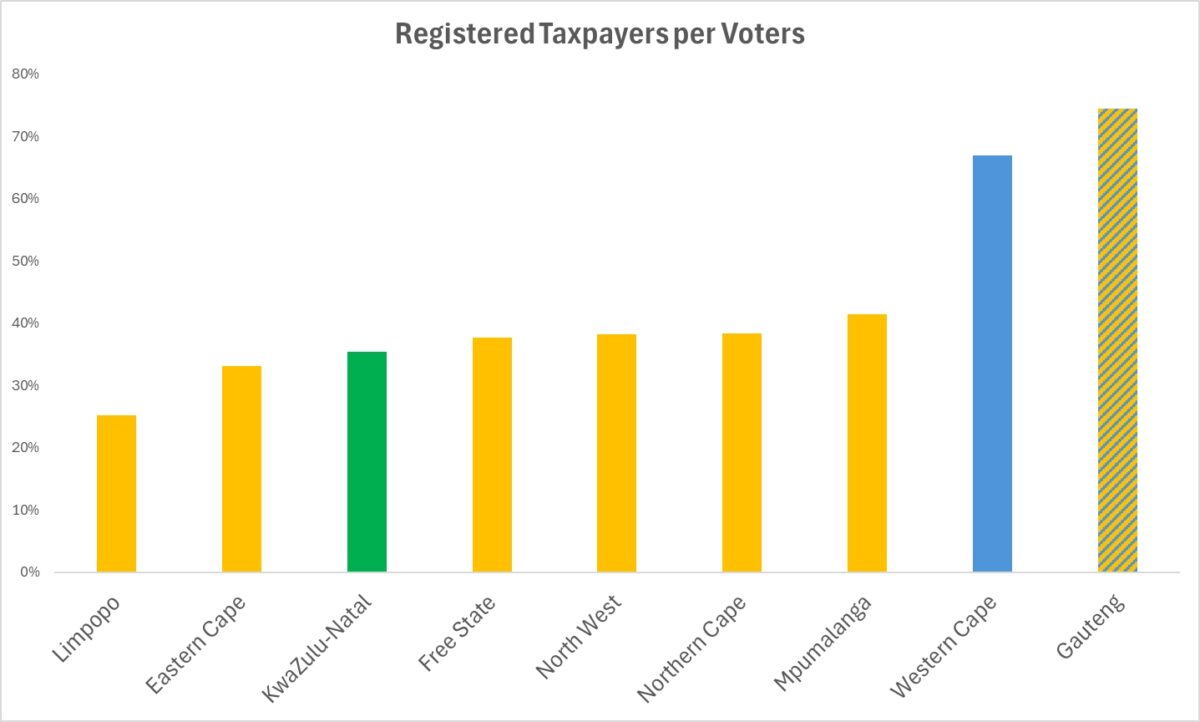
It also revealed that Gauteng had the highest percentage of registered taxpayers per voters, at 74%. The Western Cape ranked second at 67%.
Gauteng and the Western Cape were the only provinces in South Africa where the majority of voters were registered taxpayers.
All the other provinces had a registered taxpayer-to-voter ratio below 41%. The worst province was Limpopo, with a ratio of only 25%.
It is also worth noting that while Gauteng and the Western Cape accounted for 55% of registered taxpayers, they accounted for only 37% of voters.
The Democratic Alliance (DA) performed well in Gauteng and the Western Cape, which had a high ratio of registered taxpayers.
This confirms that the DA is popular among rich and middle-class residents in South Africa’s major cities – Cape Town, Johannesburg, and Pretoria.
The ANC dominated all poorer provinces, which had a much lower registered taxpayer-to-voter ratio. The only exception is KwaZulu-Natal.
Here, the Zulu nationalist party, uMkhonto we Sizwe, dominated the 2024 South African provincial elections.
The chart below shows South Africa’s registered taxpayers-to-voters ratio across the country’s nine provinces.







 Loading ...
I picked up sensationalised depictions of this article on SM, so I fact checked and then looked at national stats – employment vs. percentage of eligible voters who pay income tax (all people pay tax). Both show a decline since 1994, with a relatively stable difference of ˜30%. People who pay income tax are people who have jobs (generally) and are paid the minimal taxable amount.
I’ve not done any analysis, but I suspect that income tax payers may be taken as a sub-set of those employed (mostly). The downward trajectory of both is a problem.
This article is a conversation starter, but unfortunately has led to a lot of anti-democratic opinions being shared.