
SIU to probe years of alleged financial graft in KZN municipality


President Cyril Ramaphosa has signed a proclamation allowing the Special Investigating Unit (SIU) to investigate serious maladministration of the uMzinyathi District Municipality in KwaZulu-Natal.
The SIU has been called in by the municipality to recover funds and investigate procurement and contracting matters following allegations of maladministration and improper or unlawful conduct.
Located in the northern, central area of KwaZulu-Natal, the district lies between the main N3 corridor between Durban and Gauteng, and the coastal corridor along the East Coast.
The district has struggled to provide basic services to its residents for years and has previously been flagged by the Auditor General for financial irregularities and unauthorised spending.
Kaizer Kganyago, Spokesperson at the SIU, said that Proclamation 305 of 2026 allows the SIU to investigate and determine whether contracts and related payments were conducted in a manner that was not fair, competitive, transparent, equitable or cost-effective.
This relates to the supply, installation and maintenance of ground dual static tanks and fuel, as well as the lease and subsequent purchase of a generator for the Vants Drift Water Treatment Plant in Nquthu.
“The SIU will also probe any potential violations of applicable legislation, National Treasury guidelines, and the municipality’s own policies and procedures,” said Kganyago.
The proclamation covers allegations between 1 March 2020 and 21 November 2025, but allows the special investigating unit to investigate any conduct before or after this period that is relevant or connected to the investigation.
The SIU said that employees or officials in the municipality are under suspicion of illegal appropriation of public funds, irregular acts involving state property, and intentional or negligent loss of public funds.
Additionally, the investigation will cover relevant offences under the Prevention and Combating of Corrupt Activities Act and unlawful or improper conduct resulting in harm to public interests.
Years of financial irregularities and service delivery failures
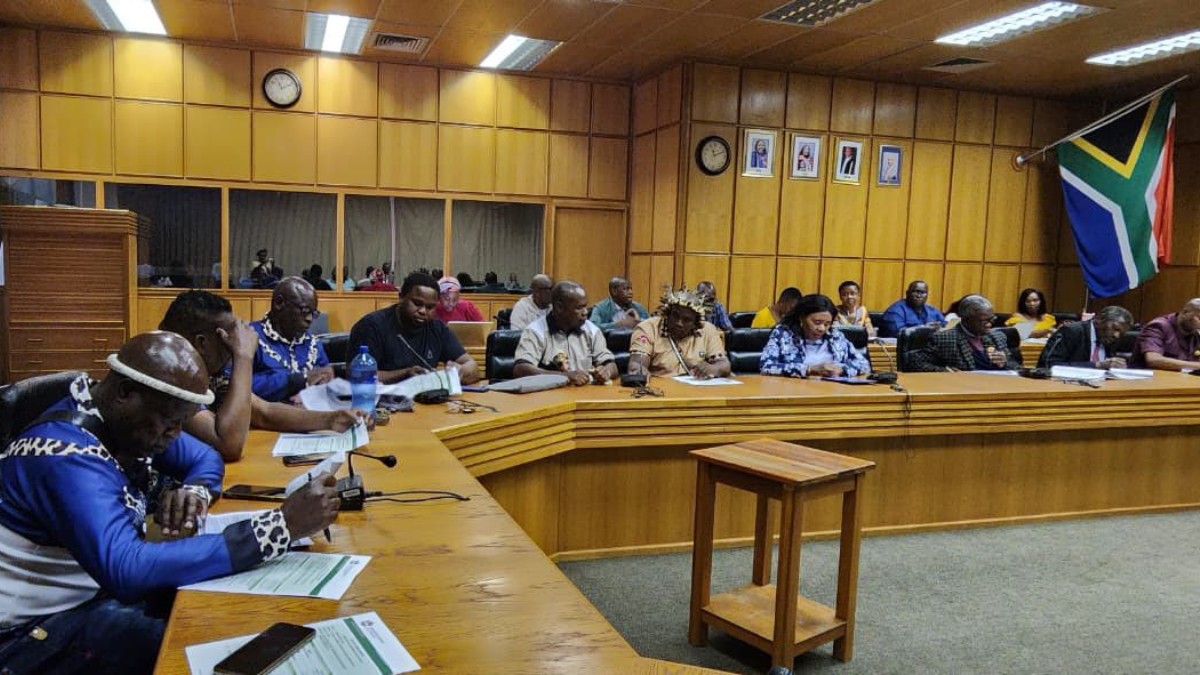
The municipality covers an area of 8,079 square kilometres and a population of 456,452 people.
It consists of four local municipalities: Endumeni, Umvoti, Nquthu and uMsinga. It includes some of the poorest and most underdeveloped rural areas of KwaZulu-Natal.
Of the total population, 93% are rural, and 7% are urban, with the main urban centres being Dundee and Greytown.
The district municipality is governed by the Inkatha Freedom Party (IFP), which won an outright majority vote in the 2021 local government elections.
Prior to the announcement from the SIU, the Parliament Portfolio Committee on Cooperative Governance and Traditional Affairs (COGTA) and the Standing Committee on Public Accounts visited the municipality.
This was part of an effort to engage municipalities identified by the Auditor General (AGSA) as distressed or dysfunctional.
The AGSA highlighted a persistent trend of poor audit results while briefing parliament on the 2023-2024 local government audits.
For the 2023/2024 financial year, the District Municipality received an adverse audit outcome for the third year in a row, after receiving a qualified audit opinion in 2020/2021, and a Disclaimer audit opinion in 2019/2020.
uMzinyathi was found to have incurred R1.4 billion in irregular expenditure, and R233 million in unauthoried speding, as well as R42 million in fruitless and wasteful expenditure.
In addition to financial irregularities, the municipality is failing to supply its residents with basic services.
According to Northern Natal News, a petition has been drawn up by residents and ratepayers across Umzinyathi, raising concerns about service delivery failures, billing problems and water supply interruptions.
Many residents report not receiving monthly municipal statements, leaving them unable to verify charges or manage accounts. Reports of inconsistent and excessive billing are also part of the petition.
SIU’s corruption clampdown
The SIU has had relative successf in combatting corruption in South Africa.
In 2025 alone, the organisation closed 3,962 investigations and exposed major corruption networks through referrals to the National Prosecuting Authority (NPA).
The unit recovered R1,3 billion in public funds and referred evidence to civil proceedings for a total of R12.1 billion worth in the year.
The SIU is, however, limited as it does not have automatic investigative powers and can only act on proclamations from the president.
“The SIU is a powerful tool, but its dependence on presidential proclamations means it’s only as independent as the political will behind it,” said political analyst Ralph Mathekga in an eNCA interview.
There is, therefore, always a risk that politically inconvenient cases are sidelined. It begs the question why it has taken years of irregularities and allegations of misconduct for the investigation to be launched.
The SIU’s findings are also not binding. It can only recommend disciplinary action to the relevant authorities. The adoption of these recommendations has been intermittent.


 Loading ...
Don’t look only there. This happens everywhere.