
The South African government is hoarding land



Although there have been numerous promises and policy statements to empower black farmers to own land, the South African government is holding onto roughly 2.5 million hectares of land.
The failure to release this land adds to the ongoing frustration over the minimal contribution of black farmers to commercial agricultural output.
These views were presented by Wandile Sihlobo, chief economist of the Agricultural Business Chamber of South Africa (Agbiz) and a member of President Cyril Ramaphosa’s Economic Advisory Council.
Writing on key policy areas that the South African government must prioritise to boost its agriculture in 2026, Sihlobo said that the Department of Land Reform and Rural Development “has, quite frankly, been dismal in 2025.”
“We did not see any meaningful progress on land reform beyond a few high-level policy statements that sought to spark more conversation rather than implementation,” said Sihlobo.
The South African government has initiated the “Pro-Active Land Acquisition Strategy”, which strategically buys high-potential agricultural land, holds it in a state trust, and leases it to Black farmers.
Sihlobo noted that the South African government has roughly 2.5 million hectares of land for this strategy. “This land must be released to deserving beneficiaries with title deeds,” he said.
The Agbiz chief economist said that the Department of Land Reform and Rural Development should refocus on the approach previously led by former minister Thoko Didiza.
This approach supported land release through a Land Reform Agency endorsed by organised agriculture and the Land Bank.
“The failure to release this land adds to the continuous frustration of the minimal contribution of black farmers to commercial agricultural output,” said Sihlobo.
At the time, then-minister Didiza was looking to establish the Agency, which was met with support from many in the sector.
“The Department… must revive such conversations and reconnect with farmers. The approach, though, must not be the never-ending meetings, but more action-oriented,” concluded Sihlobo.
The big land debate in South Africa
South Africa’s land debate centres on correcting racial inequality in land ownership created by colonialism and apartheid.
Laws such as the 1913 Natives Land Act and apartheid-era forced removals dispossessed millions of black South Africans, leaving lasting landlessness and insecure tenure.
Since 1994, South Africa’s land reform agenda has been framed around land redress.
In policy terms, the emphasis has been on transferring land to black South Africans and addressing racial inequality in ownership patterns.
In practice, however, much of the land made available through post-apartheid reform has remained under state ownership.
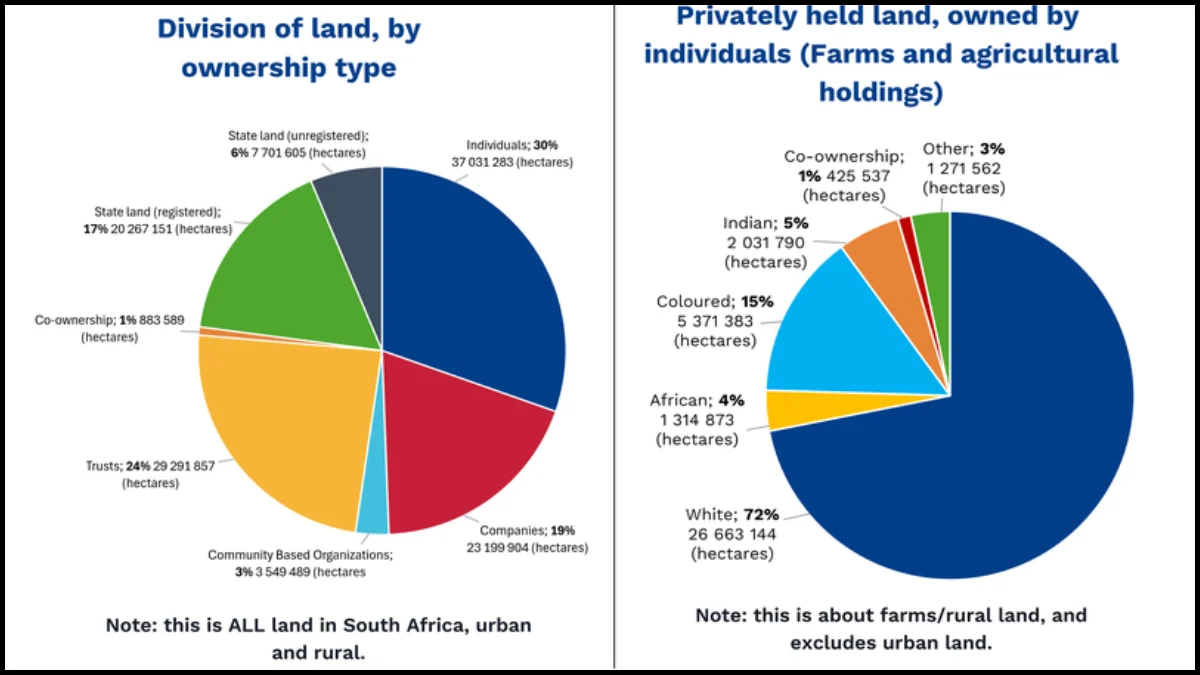
It is often said, without proper contextualisation, that 72% of the country’s farmland is owned by “white” people as opposed to only 4% owned by “black” people.
Terence Corrigan, Projects and Publications Manager at the Institute of Race Relations, explained that the data showing the 72%-4% split comes from the official 2017 land audit report.
This data pertains only to freehold land owned by individuals and registered at the Deeds Office.
The report indicates that people of colour own 15% of this land, Indian people own 5%, “others” own 3%, and co-ownership schemes account for 1%.
However, the IRR notes that land under these conditions represents roughly a third of the total land in the country.
While often labelled as farmland, much of this land is better categorised as “rural” land, as a significant portion is not used for agriculture.
Landholding across South Africa – urban and rural – is held in the following manner:
- Individuals, 30.4%;
- Trusts, 24%;
- The state, 23%;
- Companies, 19%;
- Community-based organisations, 2.9%; and
- Co-ownership schemes, 0.7%.
“It is revealing – and damaging – that the narrative constructed around the 72%-4% split conveys the message that ‘nothing has changed,’” said Corrigan.
“It erases the modest land reform successes that have been achieved, since this tends to happen through community rather than individual schemes.”
“It also ignores recognising that land to which black people have historically had access – the erstwhile homelands – has been state property and remains so three decades after the transition,” he added.
Current strategies primarily focus on long-term leases through the Proactive Land Acquisition Scheme (PLAS), rather than immediate title deed transfers.
The government’s position emphasised that land redistribution is based on providing black farming households and communities with 30-year leases, renewable for an additional 20 years, before considering ownership transfer.
This means that one can only expect ownership after 50 years of using the land.
This approach is evident when the government contested a court case to revoke an agreement to sell land to African farmer David Rakgase, which he was using.
The IRR noted in 2025 that, while recent iterations of the State Land Lease and Disposal Policy have been more open to freehold ownership, a much more significant issue remains.
“It is impossible to understand the state of landholding without reference to the heavily statist mindset and distrust of private property rights for black people that have been a long-standing feature of it.”
“Indeed, recent changes to the legislation governing Communal Property Associations deprive such property owners of the right to make key decisions over their holdings.”
Recent statements by the Minister, Mzwanele Nyhontso, and other officials emphasise the need for comprehensive post-settlement support, blended finance, and infrastructure provision.
They said that this is to help emerging black farmers succeed commercially, regardless of the land tenure model.






 Loading ...
I assume the 24% Trust land is tribal land. How many black farmers farm on tribal land? Must be a lot, judging by the loose cattle, goats and sheep grazing on the side of the road and is a traffic menace. Historically the Dept. of Agriculture in the new South Africa was a mess. They appointed “Consultants” (read cadres) who were supposed to mentor emerging black farmers. The whole thing fell to pieces. Sinerely hope it is better now.