
The high school that introduced rugby’s roots to South Africa



While the codified rules of rugby football were introduced in South Africa in 1875, the first instance of the game played in the country was initiated by the headmaster of Bishops Diocesan College.
This was known as Winchester football, or Winkies, a game that resembles the rules of rugby but is played with a round ball.
Winchester football dates back to the 17th century and was played in the street between Winchester College scholars, where players would attempt to get a ball from one end to the other with little in the way of rules.
Canon George Ogilvie became headmaster of Bishops in 1861 after helping found St George’s Grammar School three years earlier.
He introduced an adapted version of the game, which he had learned during his time at Bradfield College in the UK, during his first year as headmaster.
Ogilvie was known to his students as “Gog”, earning the game the nickname “Gog’s game”.
Ogilvie soon arranged the first public Winchester football match in South Africa, which took place between the officers of the 11th Regiment and the Civil Service on the Green Point racecourse, then located next to Somerset Hospital.
The Cape Times reported that the event attracted an “immense crowd of onlookers”. However, it also noted that “we have never seen so plucky a game played for one hour and three quarters and no goal gained by either side”.
The game was eventually postponed after the wind shifted in favour of the Civil Service’s goal, and the officers decided they had an unfair advantage.
Once the contest was moved to a pitch, players would score by kicking the ball over the goal line, which, like rugby, is at either end and spans the entire width of the field. However, they do not need to dot the ball down.
Teams also comprise 15 players, with the majority forming part of the hot or scrum. Unlike rugby, ten players form part of the scrum and are not allowed to pick up the ball.
Only the kicks, similar to the fullback in rugby, may pick up the ball. Others may catch it, but may not handle it in any other way.
A Winchester football pitch is also significantly smaller than a rugby one, measuring 80 metres long by 15 metres wide, and is lined with netting along the sides.
Rugby arrives in South Africa
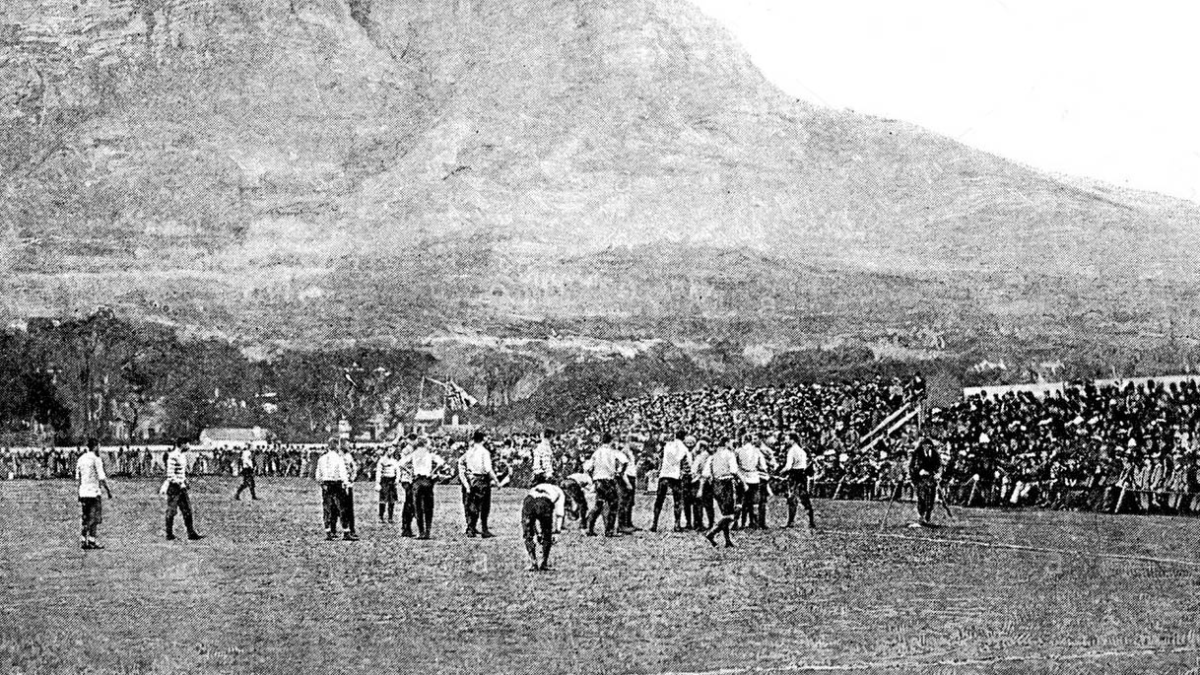
In 1875, South Africa’s first football club was formed, today known as Hamilton’s Rugby Club, which adopted the Gog’s game rules.
That same year, Rugby football rules were introduced in the Cape Colony by British colonists, many of which were working as miners.
It was only in 1879 that these rules were popularised after two Englishmen, Joey Milton and Billy Simkins, tried to convince footballers in the Cape to play the game.
By the end of the year, Cape Town had almost entirely abandoned Winchester football in favour of Rugby football.
The game gained popularity in the early 19th century, with the rules first adopted by the Rugby School in England, and were codified in 1845.
It was only in 1871 that the Rugby Football Union was founded, with the first recognised international match taking place between England and Scotland that same year.
Teams initially comprised 20 players. However, this was reduced to 15 the year before the game arrived in South Africa.
After the sport began to grow in and around Cape Town, the Western Province Rugby Football Union was formed in 1883.
The Griqualand West Union was formed in 1886, followed by the Transvaal Union in 1889. The South African Rugby Board was founded in Kimberley in 1889.
Despite the enthusiastic uptake of the game by coloured and black populations in the country, non-white players were excluded from these unions.
It was only after apartheid was abolished that the segregation of rugby teams ended. This saw the merger of the South African Rugby Board and the non-racial South African Rugby Union in 1992.
South Africa was then readmitted to international rugby after being banned in 1977. The country went on to win its first Rugby World Cup in 1995.





 Loading ...