
Durban beaches get all clear despite failing water quality tests



The Democratic Alliance (DA) is concerned that the eThekwini Municipality is deceiving holidaymakers by claiming that all 23 Durban beaches are safe for swimming, with thousands set to visit the area this December.
The municipality has struggled with high levels of E. coli since 2022, when its beaches lost their blue-flag status due to water quality issues.
Since then, the municipality has conducted regular, fortnightly water quality tests. On 30 September 2025, eThekwini reported that five beaches were not safe for swimming due to high contamination levels.
This included Reunion Beach, Winklespruit, mDloti Main Beach, uMhlanga Main Beach and Bronze Beach.
The E. coli count is measured per 100 ml; according to the Durban Institute for Water and Wastewater Technology (IWWT) 0-130 is the ideal water quality. Levels below 200 are acceptable and still safe.
Any count above 200 is considered poor quality, and above 400 is considered critical. These beaches should not be used for recreational purposes.
These five beaches were found to have an E. coli count above 200.
On November 3, the municipality reported that, while these beaches reopened, another two beaches, Anstey’s Beach and Reunion Beach, were closed due to high contamination levels.
These variations, according to Professor Faizal Bux from the IWWT, are not uncommon. Contamination levels can change daily, depending on various environmental parameters, he explained.
In eThekwini’s latest water quality tests, taken on 26 November and available on the municipality’s water quality webpage, six beaches were found to be unsafe for swimming.
These were: La Mercy, Bronze Beach, Virginia Beach, Treasure Beach, Umlaas Beach, and Umkomaas.
Of these, Bronze Beach is one of eThekwini’s 23 swimming beaches. The tests taken on 25 and 26 November showed that the water contained an E. coli count and an Enterococcus count of over 500, well over critical levels.
eThekwini putting tourism above safety – DA
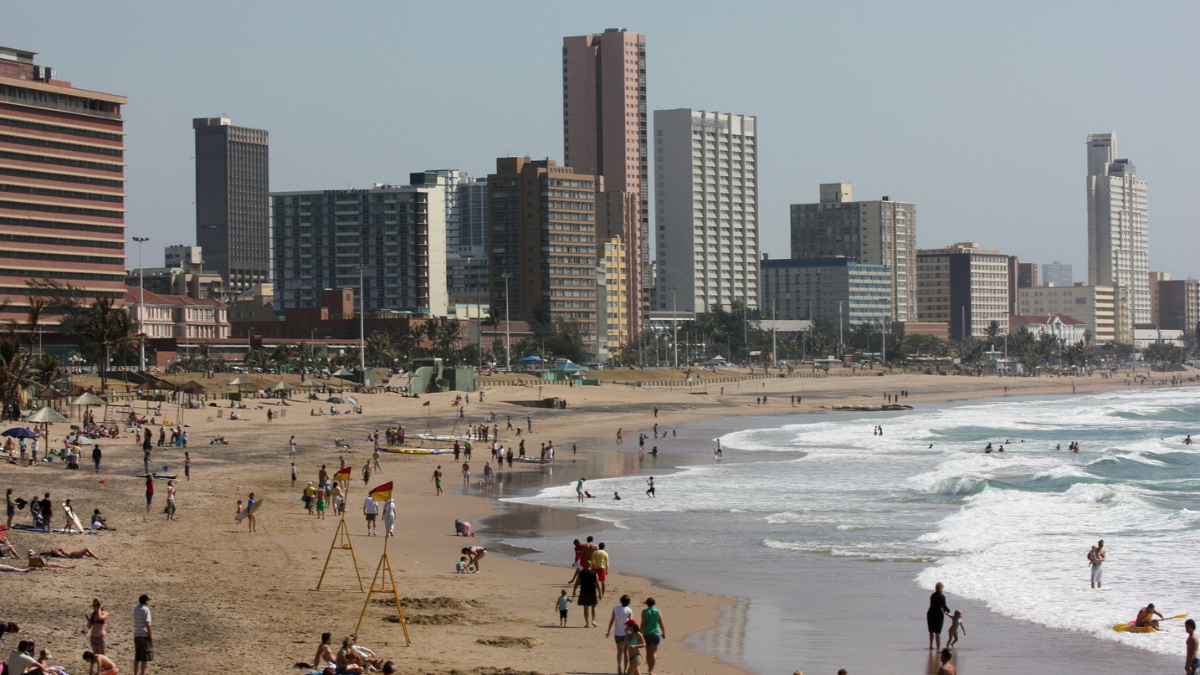
Given that eThekwini reported beach closures due to high levels of contamination as recently as 26 November, the DA’s eThekwini Executive Committee member, Yogis Govender, is “deeply concerned that the municipality is not being honest” with the latest results.
In a social media post on 3 December, the municipality said that Bronze Beach’s E. coli count had suddenly dropped to 209, making the quality ‘acceptable’ by the municipal standards.
These differ from the institute’s thresholds, regarding any contamination count below 500 as acceptable for swimming. By the IWWT’s standards, Bronze Beach would be considered ‘poor’ quality.
By these standards, Country Club Beach, Thekwini Beach, Laguna Beach, and Umhlanga Main Beach would also be regarded as ‘poor’ quality.
Govender said that the city had attempted to further lower its contamination benchmarks recently.
eThekwini said that its “steadily advancing restoration efforts” have resulted in all beaches reopening and brought the coastal facilities back to the high standards enjoyed before the April 2022 floods.
Heavy floods during 2022 overwhelmed Durban’s sewerage systems and caused river pollution.
The incident damaged critical water infrastructure, making it difficult to treat sewage and maintain safe water quality levels in beaches and rivers.
Bux explained that the high contamination levels can be attributed to a number of factors, including sewage pump stations discharging into rivers such as the Umgeni River.
It could also be caused by ineffective wastewater treatment plants that release poor-quality effluent into rivers or stormwater runoff.
This has resulted in years of Durban’s beaches being stripped of their blue-flag status, which the municipality has not regained in 2025.
“The city has not explained how beaches rated as ‘poor’ in November could suddenly be declared safe, especially when it only tests the water every two weeks,” he said.
Govender believes the municipality is misleading the public and ignoring evidence proving that the water quality is not safe.
“With more than a million visitors expected during the festive season, it appears the municipality placed tourism image above public safety, which is irresponsible and dangerous,” Govender said.










 Loading ...
Floods were 3 years ago. What progress has been made to fix sewage issues, I am willing to take a small bet that very little has been done and what has been done has no been effective.