
Ramaphosa hits back at Trump’s ‘blatant misinformation’ about South Africa



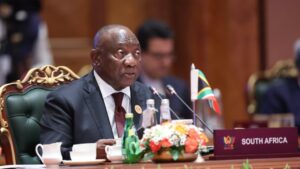
President Cyril Ramaphosa has responded to United States (US) President Donald Trump’s announcement that South Africa would not be invited to the 2026 G20 Leaders’ Summit, calling it rooted in “blatant misinformation.”
In a televised address to the nation on 30 November, Ramaphosa said that it was “regrettable” that the US chose not to participate in South Africa’s G20 Leaders’ Summit or the final meetings leading up to it.
“It is even more unfortunate that the reasons the US gave for its non-participation were based on baseless and false allegations that South Africa is perpetrating genocide against Afrikaners and the confiscation of land from white people,” said Ramaphosa.
The 1948 Genocide Convention defines it as committing certain acts with the intent to destroy, in whole or in part, a national, ethnic, racial, or religious group.
Trump has cited this issue to justify measures such as imposing tariffs on South Africa, reducing aid, and supporting refugee applications for Afrikaners in the United States.
Recently, the US President cited this in a social media post when he said that South Africa would not be invited to the 2026 summit.
However, Ramaphosa said that “this is blatant misinformation about our country.”
South African officials have vehemently denied these allegations, saying that while violent crime levels are unacceptably high in the country, they impact all races.
The President added that the stance taken by the US administration has been influenced by “a sustained campaign of disinformation by groups and individuals within our country, in the US and elsewhere.”
“Those spreading disinformation are endangering and undermining South Africa’s national interests, destroying South African jobs and weakening our country’s relations with one of our most important partners.”
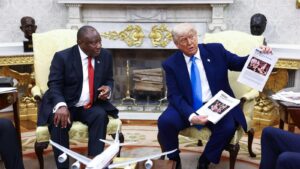
Africa Check debunked several claims Trump made about a genocide during a May 2025 meeting with Ramaphosa.
“There is no evidence that white farmers in South Africa are more likely to be murdered than other groups,” wrote Africa Check researcher Keegan Leech.
Regarding the invitation to the summit, the President stated that, as one of the founding members of the G20, South Africa is “a member of the G20 in its own name and right.”
“We will continue to participate as a full, active and constructive member of the G20.”
Ramaphosa emphasised that the US, as South Africa’s second-largest trading partner, remains critical to the country.
“We offer the people of the United States nothing but goodwill and friendship. We affirm our commitment to continue to engage in dialogue with the United States government.”
The US has its sights set on South Africa

As relations between South Africa and the United States have worsened in recent months, three laws have been suggested to impose penalties on South Africa.
Apart from the above-mentioned issues, tensions can be traced back to key issues, including South Africa’s case against Israel at the International Court of Justice (ICJ) in 2024 and the deepening of BRICS partnerships.
Several US lawmakers have introduced bills in 2025 that could significantly reshape Washington’s political and economic relationship with South Africa, targeting both the ANC-led government and the country’s preferential trade access to the American market.
The US–South Africa Bilateral Relations Review Act of 2025, introduced by Congressman Ronny Jackson, would authorise targeted sanctions against selected South African government officials and ANC leaders.
After amendments, the House Foreign Affairs Committee advanced the bill with a 34–13 vote.
Jackson argues that factions within the ANC are undermining South Africa’s stated non-aligned foreign policy by aligning with “malign actors,”
He cited the party’s positions on Hamas, closer ties with China and Russia, and its stance on conflicts in Gaza and Ukraine.
The bill also criticises the ANC government for “chronic mismanagement,” referencing Eskom, Transnet, cholera outbreaks, and state capture as evidence of governance failures.
If enacted, it would require the president to produce, within 120 days, a list of senior officials to be sanctioned.
A parallel Senate bill, also titled the US–South Africa Bilateral Relations Review Act, was introduced by Senator John Kennedy.
While echoing Jackson’s concerns, it goes further by proposing South Africa’s removal from both the African Growth and Opportunity Act (AGOA) and the Trade Act of 1974, which currently grant duty-free access to over 1,800 US-bound products.
AGOA requires beneficiaries to uphold the rule of law, political pluralism, market reforms, anti-corruption efforts and human-rights protections, standards Kennedy argues South Africa is failing to meet.
Kennedy has also introduced the Extension and Bilateral Engagement Act of 2025, which would renew AGOA beyond its 2025 expiry, but enable the exclusion of South Africa.
The bill proposes strengthening trade ties with at least five other African countries that meet AGOA criteria and demonstrate strong democratic governance and capacity to meet US obligations.






 Loading ...
I believe there is a connection between President Trump’s remarks about “genocide against white people” in South Africa and President Ramaphosa’s statements about “genocide against Palestinians” by Israel. In my view, Trump realises that Ramaphosa’s claim is exaggerated or untrue, and he is using a similar tactic to discredit South Africa on the international stage. It’s political signalling — and unfortunately, South Africa’s own rhetoric makes it easier for others to use similar language against us.