
EFF’s 2023 ‘National Shutdown’ in South Africa cost taxpayers R368 million



The Economic Freedom Fighters’ (EFF’s) March 2023 “National Shutdown” protest cost the South African Police Service (SAPS), and ultimately the taxpayer, R368 million.
This is according to SAPS’ Chief Financial Officer, Lieutenant General Puleng Dimpane, in her testimony to Parliament’s Ad Hoc Committee investigating allegations made by SAPS KwaZulu-Natal Provincial Head, Lieutenant General Nhlanhla Mkhwanazi.
The EFF, led by Julius Malema, called for a National Shutdown on 20 March 2023, demanding the resignation of President Cyril Ramaphosa and an end to load-shedding.
Malema warned that businesses and schools that remained open could not be guaranteed safety during the protests, though the EFF denied it would engage in violence or looting itself.
Malema asked, “It was in March 2023, one day, but cost you R368 million?”
“We needed to deploy to protect and ensure that there is stability in terms of those provinces that would have been affected by this shutdown,” said Dimpane in her justification of the expenditure.
“It depends on the number of the members that you deployed to go and support the affected provinces.”
“These are operational decisions that are made to ensure that we are effective in terms of policing public order issues and ensuring stability in the country,” added Dimpane.
EFF MP Leigh-Ann Mathys challenged this, blasting the allocation as unjustified for what she called a “peaceful organisation… in the streets all the time.”
She pressed Dimpane on “what the security threat was based on,” arguing that the EFF had “never ever… had any criminality.”
Dimpane insisted she relied on operational assessments and had “no reason not to trust what informed those decisions.”
Mathys claimed this made her “the bookkeeper… just get a report and then just pay.”
Some in the meeting noted that such beefed-up state security was a precautionary measure stemming from the failures of policing in the July 2021 riots.
It had an estimated economic cost of over R50 billion, the loss of around 350 lives, and widespread job losses.
The protest
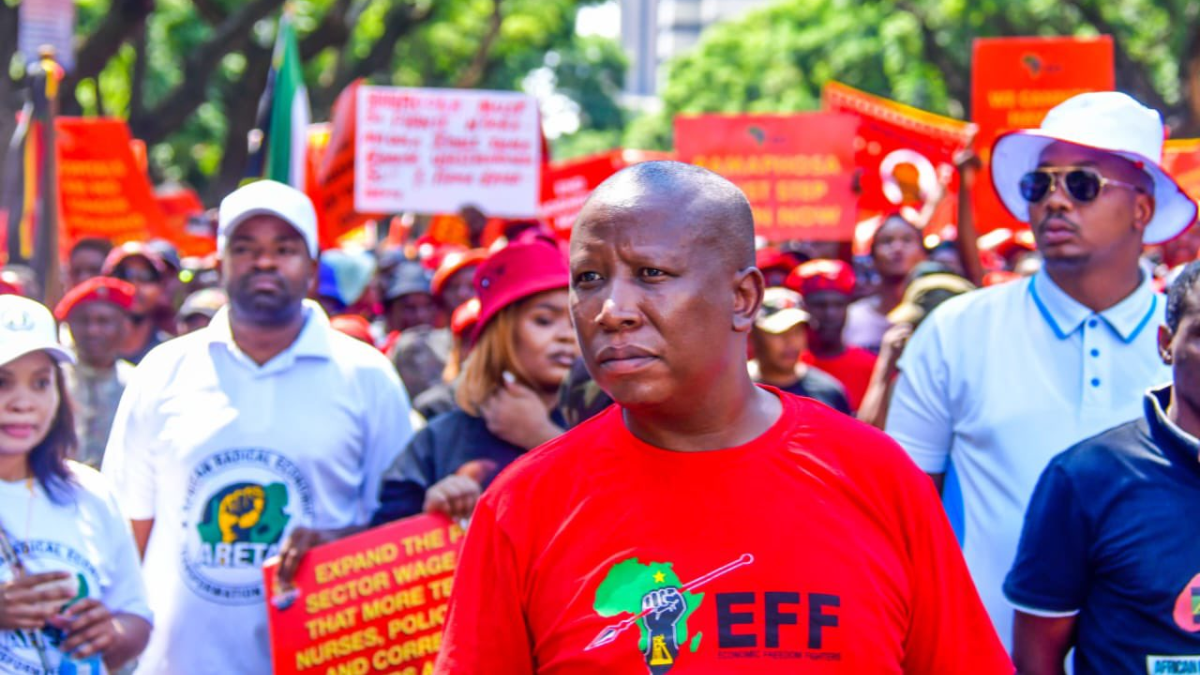
The EFF protest was backed by SAFTU, the Land Party and Carl Niehaus’s now-defunct Areta movement.
Major taxi associations, including SANTACO, distanced themselves, warning that further economic disruption would harm commuters and businesses.
In the lead-up to the protest, the Democratic Alliance (DA) secured a court interdict preventing organisers from forcibly closing shops or blocking roads, though a second bid to declare the shutdown unlawful was rejected.
Police vowed there would be no “forced” national shutdown and undertook countrywide operations to maintain order.
More than 24,000 tyres were confiscated overnight after authorities said they were being strategically placed for potential roadblocks and arson.
Protest activity was strongest in Gauteng and Limpopo. In Johannesburg, the home of EFF critic Nhlanhla Lux was allegedly attacked, while bus operator Putco suspended parts of its service, citing intimidation.
KwaZulu-Natal and the Western Cape remained largely calm, though isolated tyre-burning incidents were recorded in Nelson Mandela Bay.
Attendance was estimated at around 150,000 nationally.
According to national police spokesperson Brigadier Athlenda Mathe, 41 people were arrested in Gauteng, 29 in the North West, and 15 in the Free State.
Malema hailed the shutdown as the “most successful” in the country’s history, but later blamed cancelled charter buses, a heavy security presence and an unexpected suspension of load shedding for a lower-than-planned turnout.
Media reports, however, described participation as underwhelming and a potential setback for the EFF ahead of national elections.
The ANC thanked citizens for ignoring the call to protest, while the DA claimed its court action helped limit disruptions. AfriForum also labelled the event a failure.
The shutdown prompted a wave of misinformation, including recycled protest footage and claims by Malema that EFF action helped ease load shedding.
Eskom and Electricity Minister Kgosientsho Ramokgopa refuted this, noting that reduced demand and seasonal school holidays had already prompted lower stages of power cuts.



 Loading ...