
The province in South Africa where only 14% are convicted for protection order breaches



The Western Cape’s conviction rate of people who have violated protection orders between 2020 and 2025 sits at a mere 13.6%.
This is according to Democratic Alliance Member of the Provincial Parliament Benedicta van Minnen, who received the data in a response from the South African Police Service.
SAPS revealed that 47,457 charges were registered for violating the conditions of a protection order over the five-year period.
Despite this mountain of charges, only 6,486 of the accused were convicted during the period, a rate of only 13.6%.
However, SAPS Western Cape spokesperson Colonel Andre Traut denied that the honus of this issue lies with the police.
Of the 47,457 charges Traut said that 37,937 resulted in arrests and prosecutions. The poor performance of the conviction rate, he says, lies outside the ambit of the police’s mandate.
Data revealed by SAPS before the National Assembly’s Portfolio Committee on Police paints a picture of police negligence, which may be one of the causes, according to Action.
According to the SAPS Domestic Violence Census, it was found that “only 62.28% of police stations managed to serve the protection orders received.”
It was found that these protection orders were also improperly filed. Only 53.97% of police stations correctly filed their protection orders, while 12.19% filed them improperly, and 26.59% went missing.
The filing of arrest warrants for violations was almost identical to these figures. Warrants were improperly filed in 52.94% of cases, 12.88% were wrongly filed, and 25.51% had gone missing.
The committee also heard that conviction rates for these crimes were below 20% in all provinces.
Newsday contacted the Western Cape SAPS for comment on why conviction rates are so low, but did not receive a response by the time of publication.
Gauteng, which saw 943 convictions from 21,246 charges, had a 4% conviction rate, and KwaZulu-Natal, which had 474 of the 6,729 charges result in convictions, had a rate of 7%.
According to the Domestic Violence Act, Section 18 (4)(a), “failure by a member of the SAPS to comply with an obligation imposed in terms of this Act” constitutes misconduct.
The intention of the Act is to “provide for the issuing of protection orders with regard to domestic violence; and for matters connected therewith.”
Van Minnen said that while South Africans continue to place their trust in the criminal justice system, it is not meeting its constitutional duty to safeguard those who are most vulnerable.
She added that these numbers confirm that gender-based violence is a national crisis, and perpetrators will continue to walk free should accountability not be strengthened.
“If South Africa is to protect the vulnerable, conviction rates must increase, investigations must be thorough, and SAPS must be held to the highest standards of professionalism,” Van Minnen said.
“Violators of protection orders cannot be allowed to roam the streets without consequence while survivors live in fear.”
The party has thus demanded that SAPS leadership, the Presidency, and the Department of Justice address the matter with urgency.
Trat said that “SAPS remains committed to ensuring that victims of crime, particularly those affected by gender-based violence, are protected and receive the highest standard of policing.”
“Every effort is made to strengthen our investigative capacity, improve support to victims, and work closely with the criminal justice system to secure successful outcomes.”
Gender-based violence a national disaster
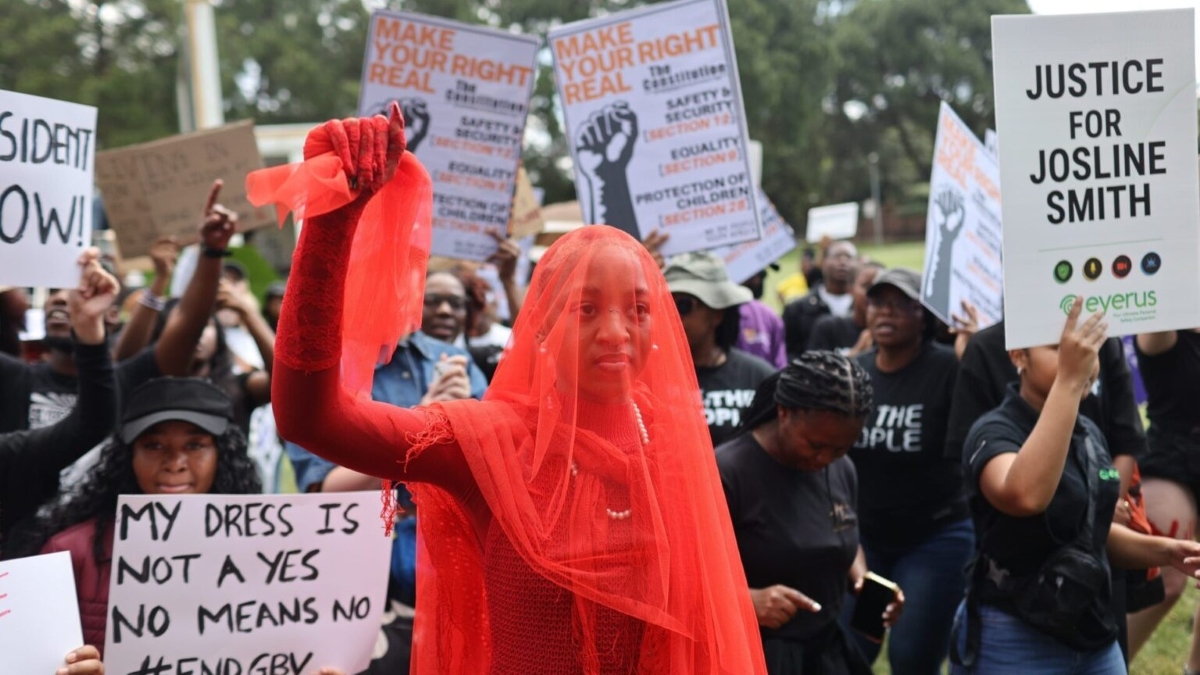
On Friday, 22 November, Minister of Cooperative Governance and Traditional Affairs Velenkosini Hlabisa announced that the National Disaster Management Centre (NDMC) was in the process of classifying Gender-Based Violence and Femicide (GBVF) as a national disaster.
The NDMC previously rejected calls by advocacy group Women for Change for GBVF to be declared a national disaster, arguing that it did not align with the Act.
As a result, the movement called for a national shutdown on Friday, 21 November. The campaign went viral on social media, with thousands of users changing their profile pictures to purple in support.
The NDMC’s U-turn on the decision follows the reassessment of previous and updated submissions from state organs and civil society.
Thus, the NDMC is now responsible for coordinating and managing the national disaster.
The classification also calls on other organs of state, the private sector, communities, and individuals to strengthen their support for the existing GBVF structure.
It is essential to note that the classification does not invoke emergency powers, but instead reinforces and strengthens the existing systems.
These include the Inter-Ministerial Committee on GBVF, the Intergovernmental Committee on Disaster Management, the NATJOINTS Priority Committee, and the 90-day GBVF Acceleration Programme.
It will also see the expansion of Thuthuzela Care Centres and the strengthening of Sexual Offences Courts.
The national state of disaster will only be revoked once the head of the NDMC concludes that it can no longer be regarded as a state of disaster, or once it expires.
The article has been edited to include comment from SAPS.










 Loading ...